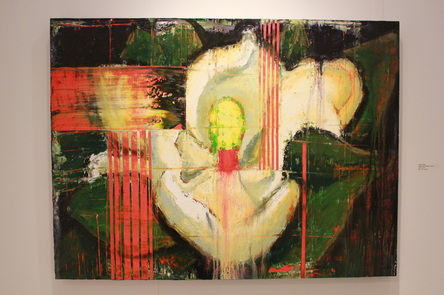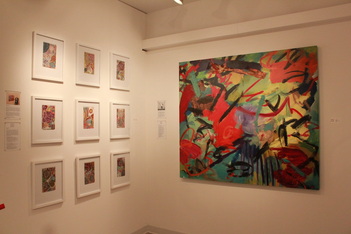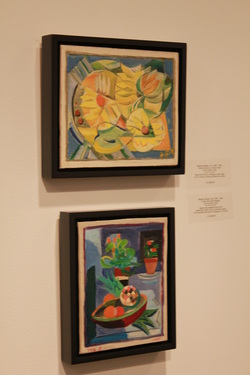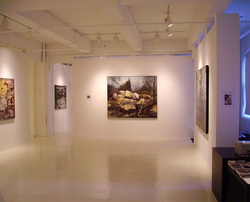
We posted some earlier work from Walter Wickiser at Art Chicago but they had more. Wickiser himself is an interesting character. He has had this gallery for over 20 years.
“Before that I was first director of first gallery from mainland China in America.” says Wickiser.
His own gallery focuses on painting, international painting—American, Asian and European artists all find a home at Wickiser. And when you see a piece at Wickiser Gallery it is, most likely a one of a kind piece. One of the artists represented by Wickiser is Ralph L. Wickiser, Walter Wickiser’s father.
“He was a well know painter, showed with Jackson Pollock, De Kooning, Motherwell, Georgia O’Keefe, all those people,” he says. “He wrote the first books on teaching Modern Art in America in the 40s and 50s. They were the most widely used texts in 600 colleges and Universities. He was close with Barnett Newman and Franz Cline.”
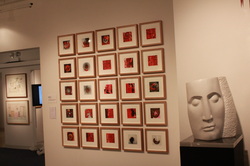
That is a pretty impressive list of compatriots and friends. Ralph Wickiser’s art stands up next to that list. “I am showing two of his different series, one from the 50s, which is of non objective monochromatic paintings. What he is best known for is a reflective stream series period from 75-85.” says Wickiser.
Ralph Wickiser’s began painting in the 1930s and his son says his work was always evolving. He painted for around 80 years. It is no wonder his son also became part of the art world.
“I was kind of born into the art world in Woodstock, N.Y. Milton Avery, the Averys, lived right behind us we were close with them. And the Kunioshis, Philip Guston. I was born into the art world.” he says.
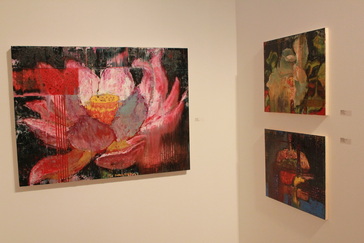
Aaron Fink attended the School of Art & Architecture at Yale for his MFA and did his undergraduate work at Maryland Institute, College of Art. I am not listing his numerous solo exhibitions and group exhibitions nor his awards. Primarily, this is because of the numerous thing I mentioned in the previous sentence. His paintings were displayed by Alpha Gallery. The gallery opened in 1967 and was initially focused on contemporary art from around Boston. Over the years they expanded both in terms of geography and aesthetics. They also have new artists exhibits alongside exhibits of masters You can find out more about Fink HERE.
OK I am not sure if the large painting is by George Lowe. My notes by this point in the day are the gibbering of a madman. And the Gallery, Tanner Hill Gallery, has a new website in the works and no real way to look around and see what is what.
But George Lowe's drawings are wonderful, even if you cannot actually see them in these photos.
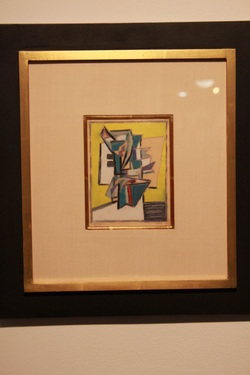
Werner Drewes Small pieces of art were on display at the Richard Norton Gallery booth at Art Chicago/Next. Again, I am working on something on collecting small art...something that is taking way, way too long considering how unprofound it is. But these works were inspirational. Drewes was German and studied under Klee, Muche and other Bauhaus notables. It isn't a leap to see his origins in his work. He moved to the USA in the 30s. In addition to painting he was a printmaker and teacher.
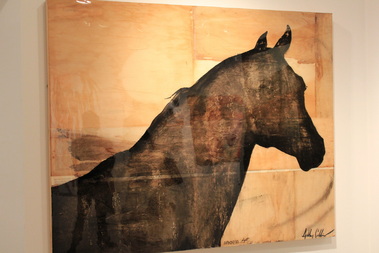
Ashley Collins' Moon was one of several pieces that stood out at the Turner Carroll Gallery booth at Art Chicago/Next 2011. There are many other examples of her work, which is oil, aged paper, panel and hand fired resin. You can see the reflective nature of the piece in my rotten photograph above. Paintings by Conrad Kern
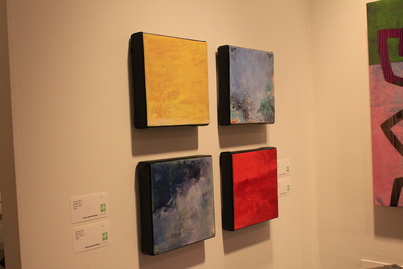
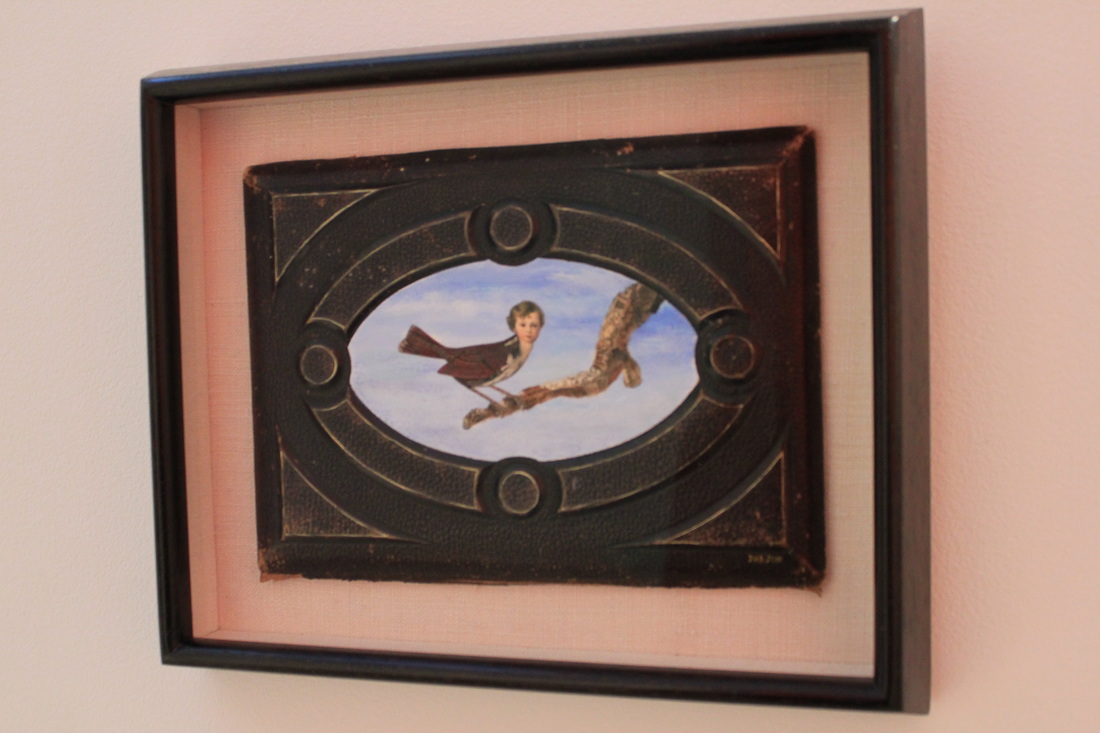
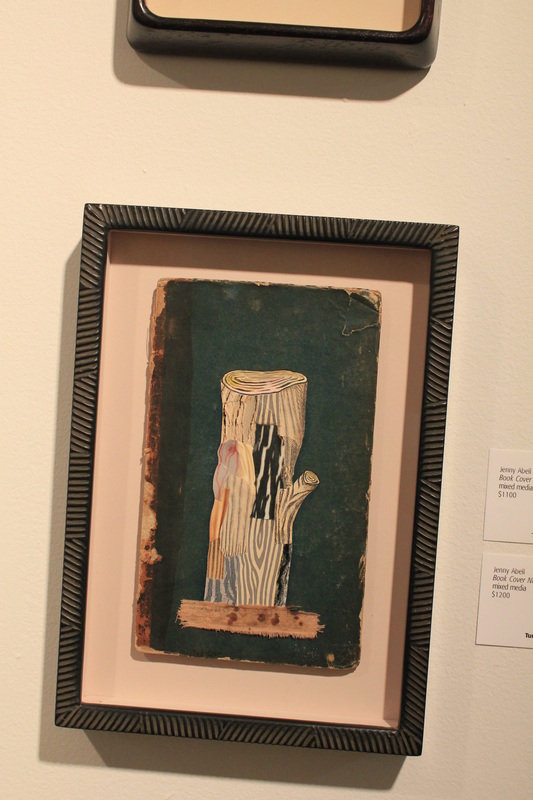
Conrad Kern was another artist who caught my eye at the Turner Carroll Gallery, in part because of my new obsession with "small art." His paintings, naturally, do not come across at ALL in the photo above. Smaller pieces inevitably come off worse in such photos; if you make them large you make them seem bigger. You can get a better idea by looking at the Turner Carroll website. Jenny Abel 's unique and meticulous "book cover" series also simply do no come across in these photos--nor even the much better photos on the gallery website. These are truly masterful works...quirky. The sort of work that, if you pause to consider them you wonder; what the HELL was this woman thinking (and I mean that in a good way). I didn't think this at the time but I was a tad ovewhelmed.
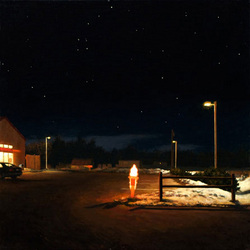
Big Dipper (not at Art Chicago) But From Frederick's Website So while wandering at Art Chicago I found paintings by Linden Frederick at the Forum Gallery booth. The folks working there were otherwise occupied (i.e. talking to people who looked like they might be reaching for a check book). I never try to chat with folks in that position! I am often entranced by a certain style of night scape painting. I am glad I didn’t take photos here as there is just no way those would even sort of work. These are realistic paintings of the evening. But, for lack of a better way of putting it, so many night scapes seem just an excuse to slop some black paint on a canvas with a beam of light aimed at a guy in a fedora smoking a cigarette. There is often an obviousness and self-conscious love of blackness in such paintings (to my dubious eyes in any case). Frederick’s paintings are nuanced and have depth. They are of the night but they are not really dark because of that alone. I am starting to sound like an art critic…brrrr. See his paintings. Not ALL of them are of the night.
Jeremy Hu is director and curator of Asymmetrik Inc., an art brokerage that specializes in photography. The company was at Art Chicago/Next displaying some truly breathtaking work. Hu took time to talk about some of the work and about being a broker versus having a gallery. He would like to someday have a gallery but, right now, he prefers being a broker—one with an impressive online gallery. And he thinks purchasing art online sales is becoming more accepted. “Yes definitely we have gone so far along into the cyber world now. I could really see how people slowly are becoming more comfortable buying art online,” says Hu. “It is still pretty much at the beginning but there is a huge demand. Of course, when you reach out online you are talking about global. So that gives you another spectrum of business and audience…” When asked if people come to events such as Art Chicago/Next and then buy the art later online, Hu answers in the affirmative.
“I would think so, there is so much to see and I do not how big this is exactly. One could get lost. Hard to see something and at that point make the purchase--unless it is something you ‘see your name on.’” he says.
Among the artists whose work he sells are Ken Shung, Christophe von Hohenberg and many others.
Antonio Capelao (I apolgize for the missing accents...they are not working for some reason) of Bicha Gallery showed the large and small works of Dr. Lisa Anderson. The small photos, 30 photos in a series of three, are titled China Red and were completed when Anderson was artist-in residence at Redgate Studios in Beijing in 2010. I was attracted to these, first of all, because they were small and I am writing something about "small art" (more on that some day). Capelao told me the smaller pieces of China Red make up a single piece. He also showed some of Anderson's other works, for which she designed a new lens. He noted the artist has accommodated collectors who wanted different size prints--so long as those prints do not compromise the clarity of the image (or something like that).
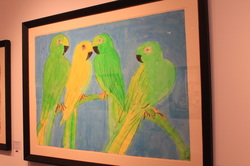
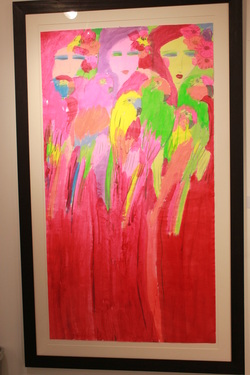
Walasse Ting was Chinese by birth but left his homeland as a teen. He went to Paris at the age of 19 and also lived and worked in New York, San Francisco and Los Angeles, according to The Catto Gallery’s Iain Barratt (Barratt did not bring up his own art, which is remarkable in its own right). Ting got to know a number of notable artists, Andy Warhol and various abstract expressionists. He produced art of the variety of the latter in the sixties. But Barratt noted he mixed traditional Chinese elements with his expressions. One of the traditional aspects of his work is how he painted it. He painted it on the floor standing up. One of his pieces is in the Guggenheim. Regretably ,Ting had a stroke 8 years ago and was in a coma until he passed away in May, 2010. “What is happening now—in past six months—is that Chinese are buying him back, claiming him as their own.” says Barratt. Auction prices often exceed gallery prices and Barratt says his work is something collectors should keep an eye on. The Catto Gallery is located in London.
 Glass Artist Extraordinaire, Dan Dailey by Patrick Ogle
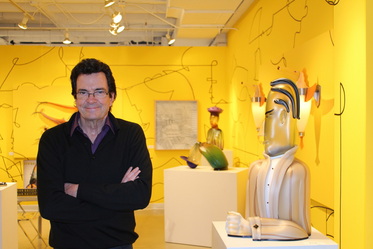
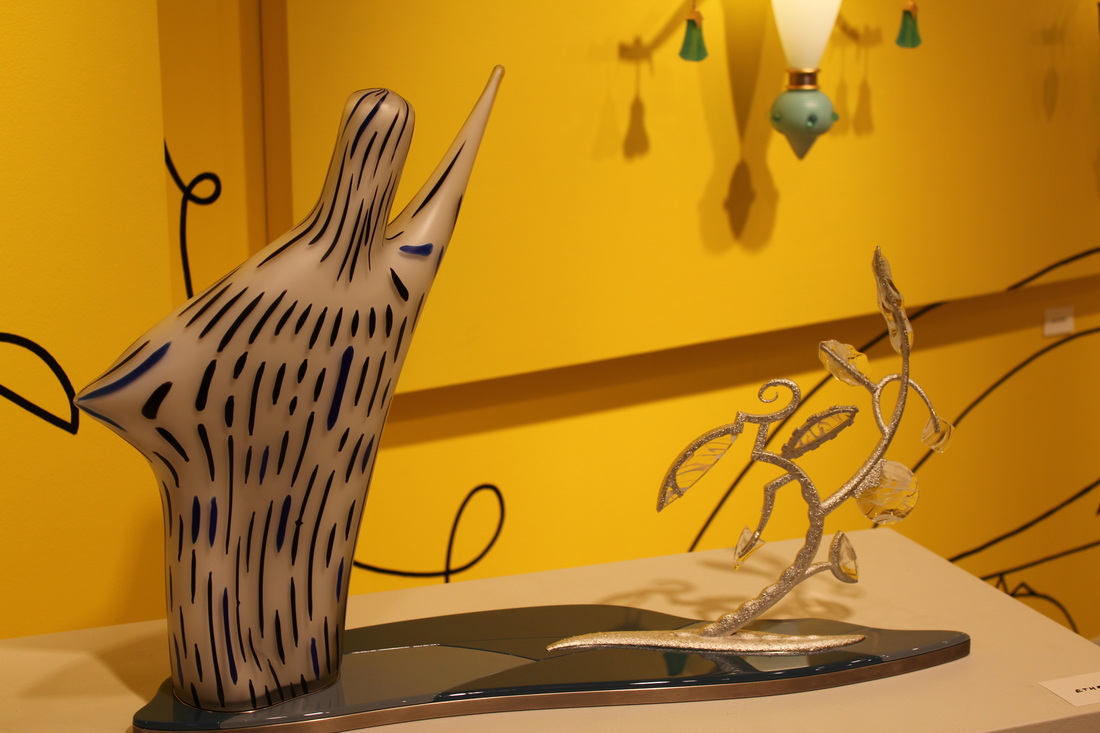
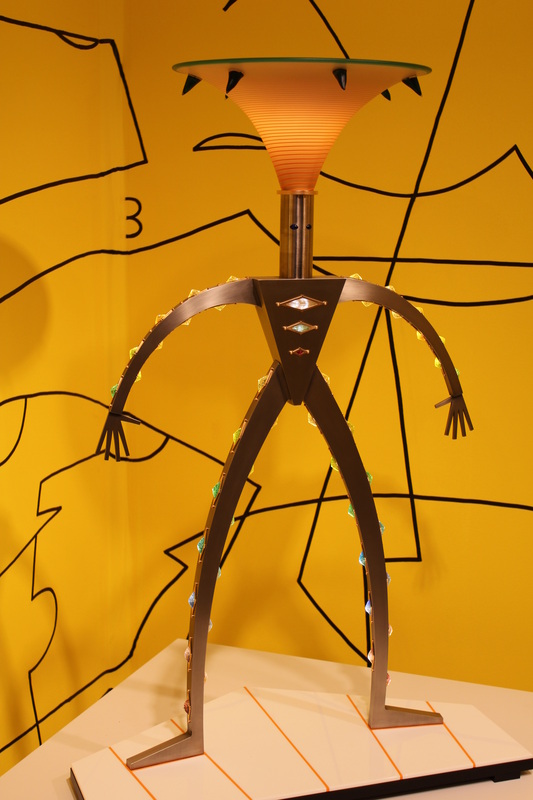
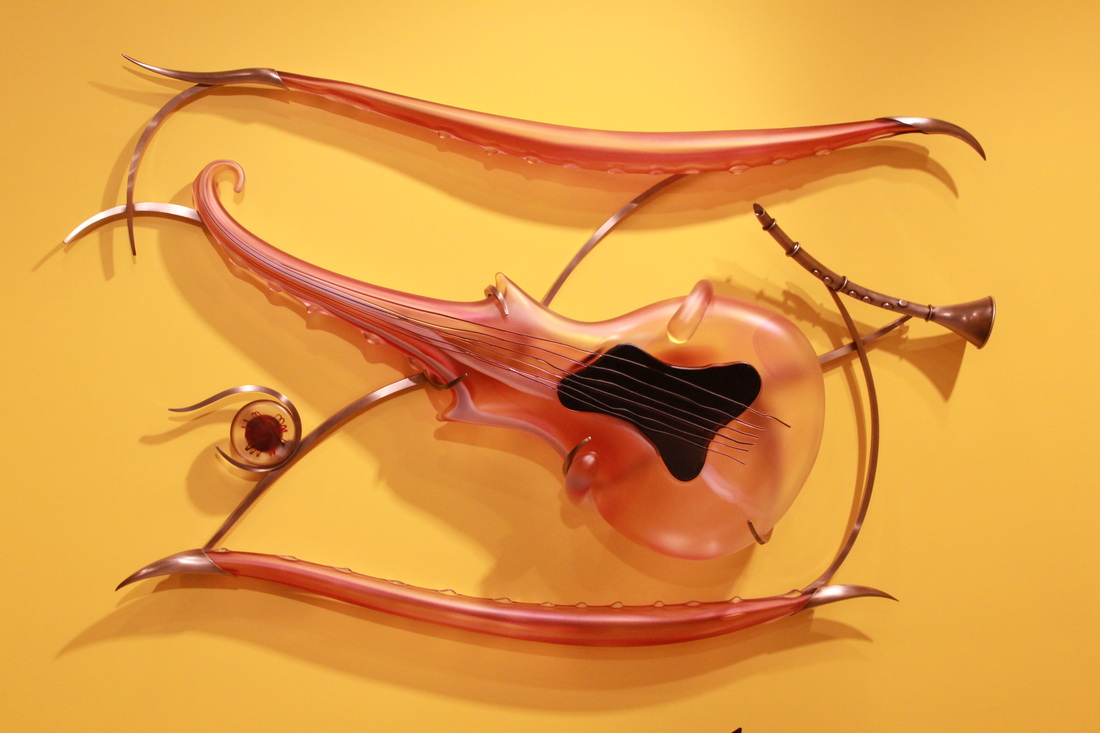
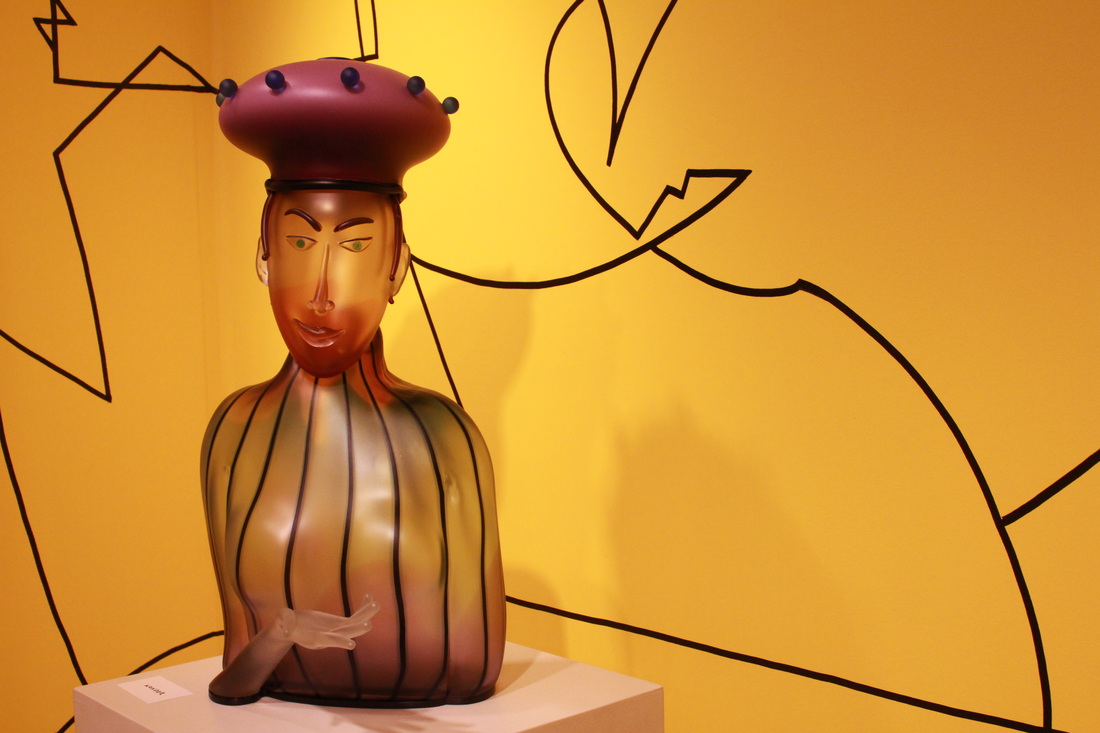
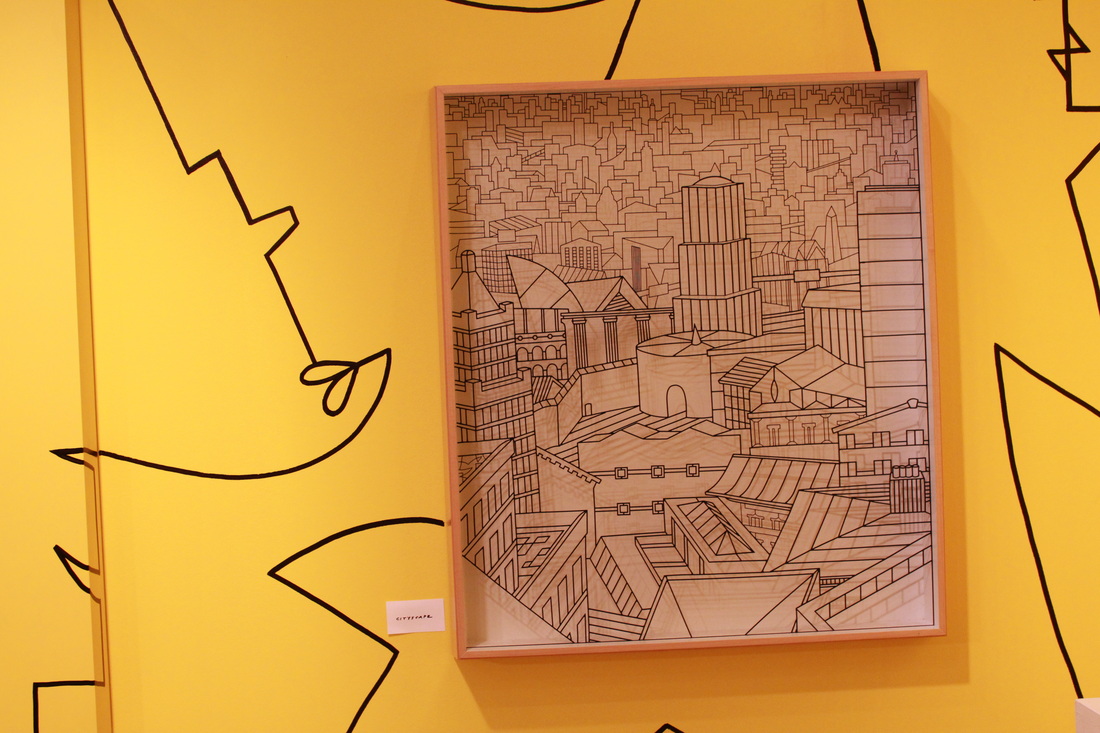
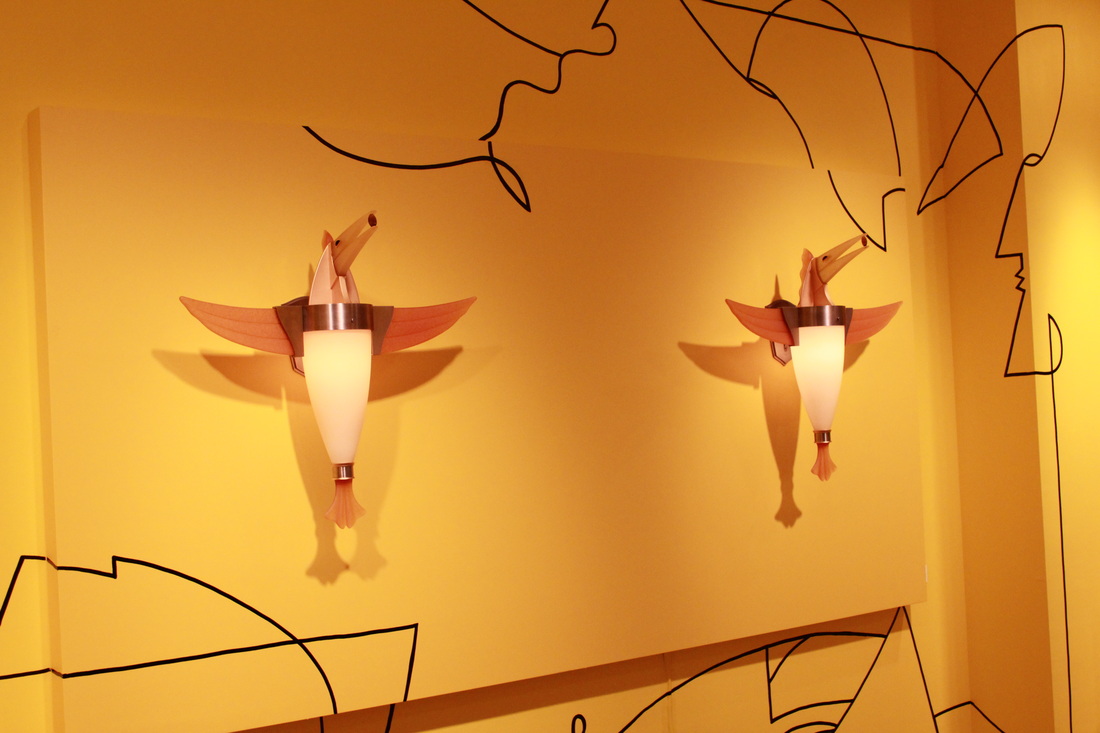
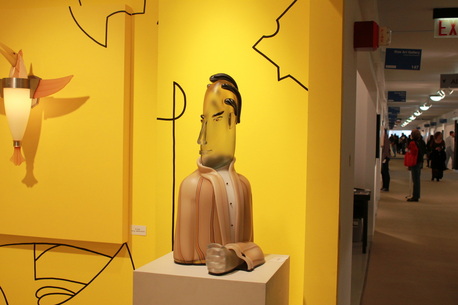
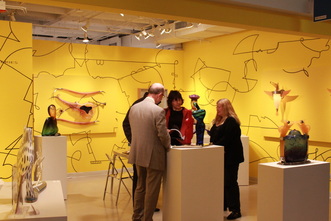
Dan Dailey is a glass artist who began working in the medium over 45 years. His list of accomplishments and his resume are far too extensive to list here. He was the recipient of a Fulbright Hayes Fellowship. He founded the glass program at the Massachusetts College of Art and Design in Boston. But when he first went into art school glass was not on his mind. “I went to art school in Philadelphia in the 60s started in 64, Philadelphia College of Art. I got interested in glass when the college was given a grant to build a glass studio. They asked me to make it so I made the studio without really knowing what I was going to do,” he says. “That s what got me interested in the material. I was making films at the time. And I was also doing illustration and making things from clay and metal so I had classes in various media.” Even though he found glass very intriguing he had no real instruction in the glass. Even his instructor was no expert. “The ceramics instructor who told me how to build the furnace and rest of the shop, he didn’t know either. It was all experimental for him,” says Dailey. “He had one class and then he became the person who administered this grant the college was given. So it was an interesting time and very exciting to try this new material and be able to do something with it.” This first studio was not exactly state of the art. “It was a terrible studio. It was out in the parking lot in an old incinerator room. You had to pull the bench out into the parking lot and sit there in the parking lot,” he says. “Open up to doors and prop a piece of metal on top of there so the snow wouldn’t fall on your head. Everyone got sick in February.” When asked if there were any “spectacular failures” because of the lack of knowledge he pauses and says, “I wouldn’t have called them spectacular. They were kind of miserable” Yet even with the conditions it was valuable experience. He did not, however, immediately continue his work in glass. He says while it was cool to work with and intriguing he wasn’t fully into it. This was when he moved to Haight Ashbury (hey…it was the SIXTIES and he was an artist!). He lived in San Francisco for awhile but eventually burned out on the West Coast and went to Rhode Island for graduate school. This was fortuitous as he became the first grad student of famed glass artist Dale Chihuly. “He became a friend-is still a good friend. I just saw him at his opening in Boston. It was a great thing.” says Dailey. This is the point where Dailey became more focused. He stopped working in any medium aside from glass--excepting some illustration classes. And for Dailey illustrations lead to and inform his glass work. “I am kind of an imagist. Everything I make is subjective, even the pieces that are more like decorative art, like these bird sconces, which are functional objects and they have strong links to Art Deco or Ancient Egypt if you kind of boil down the imagery,” he says. “But my heroes are people like René Lalique, somebody from that era where design and function were merged in a way that is deliberately beautiful and with a really strong respect for materials and materials combination to make things elegant. So that quality of making things and the use of materials and even the geometric stylization of forms is all coming from a strong design tradition in Art Deco, Art Noveau.” One of the pieces, the one next to him in the top photo, had to be made five times. The white collar on the figure just wouldn’t come out right. After so many years working in glass he says he can mostly get it to do what he wants. But ultimately, the glass still wins. It is the boss.  The 5th time is the charm. Tom Hawk from Hawk Galleries in Columbus, OH should be proud of the work he represents and also the artistic presentation at Art Chicago. It stood out from the others. There is an exhibition of Dailey's work at the gallery from May 7 through June 26, 2011.
|