Picture
Here Come The Mummies are a band out of...I guess Egypt. Although, there are mummies in Chile and other South American areas. I mean they COULD be Incan mummies I suppose. Well, anyway, they are a band who, at the very least, look like mummies and we interviewed a member of the group (Java Mummy) about the music and issues related to being dead. They are also poised to resume touring in a couple of weeks (link to dates below).


How can you play instruments after your brains have been scrambled and removed through your nose?

Easy. Once the brains have been scrambled and removed through the nose... the nose... it becomes easier than ever… ever to play an instrument… instrument. Snark. Whee-bop! At this point (wha-heem!) the student is able to express himself… himself… without over-analyzing his... activity… Snark. Whee-bop. Wha-heem!

In every movie I have ever seen with mummies they have been REALLY pissed off and killing everyone. Why is that?

 Bad catering.

How was it a bunch of dead guys got into rock n roll? Were you waiting around for 4950 years JUST for Les Paul to invent the electric guitar?


 That, and the Wonderbra.

Are you all REALLY hungry like the Mummy in that Anne Rice book? And that guy was bangin' everyone in SIGHT too if I recall (I usually try not to recall Anne Rice books).

We too possess an extravagantly enhanced libido, just as Rice's mummy does. We need neither sleep nor food to sustain us, same as Rice's. We differ in what we do constantly crave, that being a steady stream of Anne Rice novels for our general consumption. New, used, partial, dust jackets or without, hardback, doesn't matter. They are delicious when lightly toasted, stuffed with almonds and goat cheese, and paired with a nice pinot gris. We have several suppliers.


HERE COME THE MUMMIES TOUR DATES CAN BE FOUND HERE

Picture
Java Mummy
What sort of modern human music fan is going to want to hear Here Come The Mummies?

We appeal to all types of people. All types of people who feel the beat in their pants. While this may appear to be a cutesy-type, evasive, and all too general answer, we give you our ass-urance it is absolutely bona-fide.

Who are the modern musicians who inspired you to creep from the sarcophagus to jam? Likewise what inspired the upcoming LP, Cryptic? Where is it coming from musically?

Franz Shubert, Shooby Taylor, Taylor Swift, James Taylor, James Brown, Rick James, Dick Van Dyke, Van Dyke Parks, amongst many others whose names we are hard pressed to play stupid word games with off the tops of our heads. As to inspiration, we're gonna go with _______. You know what it is. You KNOW. We know you know. Don't over-think this… Whew, 'bout damn time! We knew you'd get it, though, good job, y'all.

Tell the modern human mortals what they can expect at a Here Come The Mummies show?

A super-tight, fiercely original, eight-piece band which tosses off libidinous lyrics, infectious musical confections, and which features a 5,000 year-old Egyptian mummy donning a gorilla suit to play the bongos. It'll leave your senses reeling, and burn down your inhibitions like an insurance job on an old hotel.


Picture
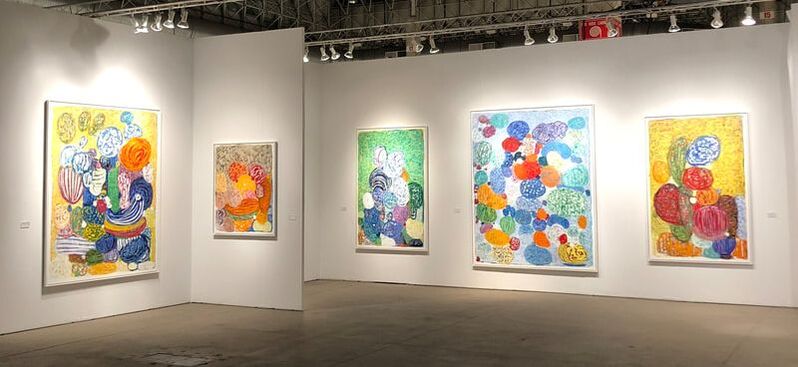
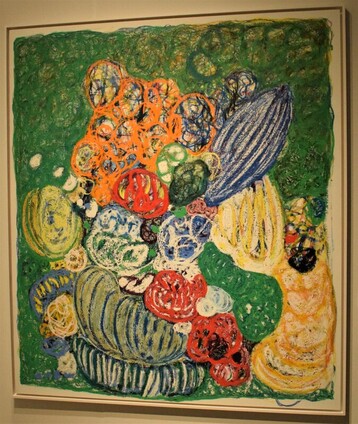
Suzanne Unrein says her paintings of flowers were inspired by how she saw flowers always moving, growing and dying and wanted to capture this in an image. Flowers have not been the object of her work before these remarkable pieces.

She begins with an image and then adapts it in her head. The end result is not a representation of a specific flower of that image but an image all it's own. She captures life and decay and motion in all these paintings. She doesn't see flowers as still life but rather being all about the motion.

Unrein has a degree in design from the University of Florida. She says, at the time this was the same as a Bachelor of Arts except you had to take an additional 16 credit hours of art history.

Her next work will be paintings of animals. She heads to Africa  this summer to work with an animal behaviorist on these pieces. Watch the video below to find out more about her process. Find out even more at her website, suzanneunrein.com.

Unrein is originally from Sacremento but attended the University of Florida (proving she had a first rate education). She currently resides in New York City.
 
 
Picture
Cuba's Pioneers is a program of education and,also, indoctrination of the nations youth. The best American analogy would be the Scouts. Certainly the Scouts are not run by the government and are only loosely connected to public education but there is an element of societal indoctrination there (which implies nothing sinister necessarily).

Cuban-born artist Dayron González explores the process of Cuba's Pioneers in his series of paintings, Pionero.

In the video below he speaks a little about the Pioneers, his art, the uniforms and more. He doesn't delve into ideology in the video or when talking to him subsequently. The images are often from above, either looking straight down on the subjects or down at an angle.

Some of the works focus on the group, all in the same uniforms, gathered sometimes in geometrical formations, unified, undifferentiated. Not all of the series are distant, some show individuals and the style of various "Pioneer"paintings also varies. You can see more at the Cernuda Arte website.

While speaking to González he asked if I knew Cuban painters. I listed those I am fond of and he replied, "Ah, the masters."  It was a little bit embarrassing; why didn't I know more about the numerous young artists coming out of Cuba?
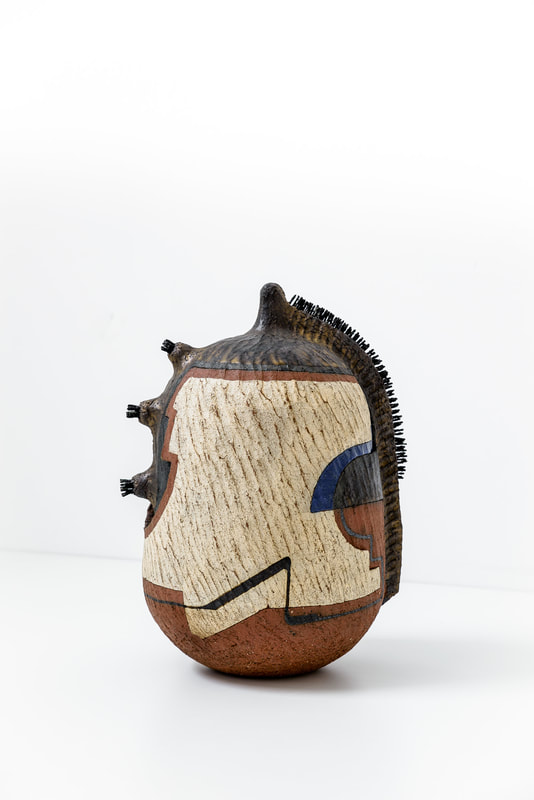
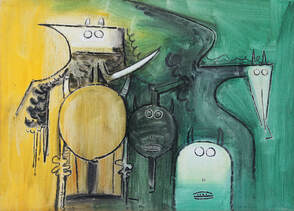
Wilfredo Lam and Rene Portaocarrero, as great as they are, are not the story of Cuban art. Young artists like Gonzalez, now working away from his homeland, carry something unique to Cuba with them. Lam also worked away from Havana in his career.

González was born in Quivicán, Provincia Habana, Cuba. He studied painting at the San Alejandro National Art Academy. He has received numerous awards for his work in Cuba.

Formación Cerrada II

Transgresión


Picture
photo by Sue Fielding
Everyone who gets into the blues has someone who got them into the blues. It never just seems to happen, there is always a blues loving sibling, father, mother or guy you met at the gas station who sat there all day with his Kay guitar.

For English musician, and blues enthusiast, Bex Marshall, it was her uncles.

“I had uncles on both sides of my family who inspired me ... One was a live rock n roll singer in the 60 s who had a huge voice and stage presence the other a very knowledgeable blues music fan who had an incredible collection of records which I used to sneakily play while he was at snooker ! Also my guitar tutor who taught me to pick ragtime blues inspired me to that roots playing.” says Marshall.

Marshall's latest record, House of Mercy, is out now.

Marshall learned as much about the basics of guitar playing as she could and says she spent her teen years listening to music ranging from ACDC to John Lee Hooker. Then she started writing on her own and, more important, traveling.

“That kind of thing grounds you and the blues music that has always been the root of what I have been into the acoustic pickin' style always challenged me so I started developing a style of playing which incorporated it all,” she says. “Then I bought my OZARK resonator ... Of which I have several now including a one off to my very own spec s.”

Marshall says she plays the blues when she is up, when she is down—and it might even be the same song.

“Blues must come from whatever provokes you emotionally. The serious tunes can make you smile too. It's the music you should feel most at ease with like an old buddy,” says Marshall. “It is the building block of all music and most respected, it’s for me it’s the most exciting genre. When you hear the first few bars of a good blues tune it gets my haunches up!”

But how does a new artist fit themselves into the rarefied world of blues. How do you fit into the time-honored and sometimes even calcified genre?

“By sticking to the basic rule of good blues--the songs, the songs have to be good. Lyrics are so important to me; I love play on words, and blues can be very repetitive, so if you gonna sing one line many times it better be a good line!” she says. “I love writing stories and the blues genre is all about stories, usually troubles that begin between a man and a woman ha, but I want to explore the music and try to push boundaries while still keeping it real, there are so many incredible influences in blues music, roots to hardcore electric blues, the main thing is arching your back and putting your heart and soul into it!”

Then there is the whole blues MAN aspect.

“It’s always tough when you try to break into a male dominated world, so you have to be made of strong stuff.  I grew up with lots of men around me in my family, so I was toughened up early. I prefer the company of men to be honest, so I am comfortable in the blues environment.  I have always had a need to strive to be as good if not better than them at what I do,” she says.
“I just want to add a slightly different dimension to the whole thing, to be original and the mission is to get under the skin of the hardcore purists and get them secretly listening. I want to take the pure and make it interesting in my own way, with as much real blues quality as I can.”

How does Marshall view playing in the USA—artists coming here to play smaller venues are often not treated as well as in Europe (by venues).

“Although I will say the USA is the home of the blues and the people know it-- The audiences rock! There is a respect for musicians here which is unrivalled anywhere else in the world I think,” says Marshall. “It is a joy to play here. Whether it’s a big club or a mom n pop bar, I feel much more relaxed playing here(the U.K.),I think, like coming home.”


Her new record House of Mercy has an interesting genesis.

“Barry my husband who booked a club called The Borderline in Soho for 6 years, wanted to buy it and after researching the location, found that St Barnabas Church ( next to The Borderline) had in the 18 & 1900's been a prostitutes refuge called the House of Mercy, he wanted to use that name for the restaurant venue above the Borderline which he wanted to transform into a weekly residency show bar for top class artists he eventually lost out in a bidding war to corporations and eventually left the club, but kept the name for our company that now that includes a weekly syndicated radio show which is produced from the Snake Pit Studios which we built in the back garden. “ she says. “It also incorporates our record company through which the record has been released. The radio show has two 'as live' radio sessions a week, taken from the wide vista of Americana, so we are always full of musicians and their music, jams happen all the time and that's where I got the House of Mercy song from and now the title of the record, it's a song that encapsulates all of my styles that eventually appear on the record. We also subsequently put up the odd band and traveling minstrels so in effect we are a refuge for musical prostitutes.”

This record was also self-produced with assistance from the engineer from previous outings.

“I wanted to have a go a producing this record myself this time around, I had learnt a lot from my first two records Bootlace and Kitchen Table and took it on this time, I have an incredible engineer who I work with called Nick Hunt and he is so fantastic to work with, he made it very easy for me, considering I’m " THE ARTIST " I was very aware about not being too precious and over indulgent about things and having a definitive goal for the record to sound like,” says Marshall. “Although I did have a certain amount of freedom in the studio, which was a luxury, I recorded the bands rhythm tracks in the same small studio I used for Kitchen Table which is about a mile from my house in Muswell Hill called Boogieback Studios, sticky carpets and amps in the bathroom etc, and a great vibe, a lot of the overdubs with the Reno Brothers, Brigette De Meyer, Eileen Healy and BJ Cole were done there.”
The mastering was done at Snakepit Studio and at The House of Mercy. She would mix with Hunt and then spend time listening to the recordings in her car (always a great way to really hear music how people listen to it—at least in the old days).

Marshall also worked as a dealer. No, not meth or smack, but in the gambling, card-tossing way. One thing that has always eluded me is shuffling cards.  So I asked if she could teach me.

“Yes there is a cool shuffle I could teach you; split the pack and hold the two packs facing outwards in both hands and squeeze gently at the top and bottom of the cards so they bend slightly in the middle towards your palms then squeeze hard so that the fly out of your hand and fly across the room ..... It’s called a 52 card pick up shuffle...heeee. My advice? Don't play cards.

Sound advice.

Marshall recently finished a tour of the USA. Be sure to keep an eye open for Marshall in tour during 2013 in the USA and Europe. This most recent tour was solo but the next will be with a band. She also hopes to hit Australia down the road.

Go for the blues, not the card tips!

Bex Marshall's Ozark Resonators


Picture
Preema Nazia Andaleeb is a visual artist working in a number of different media. The piece  at  Art Asia during Art Basel week 2012 was a video piece, Marry my Egg, revolving around that particularly vexing woman's issue, fertility.

And while women's issues in the West may differ from those in Bangladesh in many respects the notion of the woman of a certain age NEEDING to reproduce seems to afflict women everywhere.

The videos below show Preema at Art Asia and the reactions of passersby. To see her actual video go to the artist's website.

Her work has been shown around the world. Keep an eye open for her at


There was an interview with Preema but, unfortunately, before it was transcribed that interview, and numerous others, was lost in a hard drive disaster.
 
 
Picture

Photo by Glenn Campbell

&

LICHT FELD GALLERY, Basel

Tiffany Trenda creates digital environments using technology. Not fancy technology, in fact, she uses the sorts of things most people use, or at least interact with on a daily basis: cameras, video projectors, LCDs etcetera. Her work investigates how this technology has become part of us—almost literally in the sense that her work also centers on the body.

Her latest work is Body Code. Body Code premieres at Art Miami/Context on December 4, 2012 at a VIP preview from 6 to 7 p.m. and again at 8 to 9 p.m. During regular fair hours performances will take place from 1 to 2 p.m. and 3 to 4 p.m.  The performance is presented by Licht Feld Gallery. Work by Trenda will be shown at booth D56.

The piece is an examination of toxicity—of manmade chemicals and how they affect the human body. Trenda employed QR codes to achieve her end. When you scan her body with your cell phone you will be directed to the project website and a page on a particular chemical. The piece is as much about data and technology as it is a cautionary tale on dangerous chemicals.

“One day I was noticing that QR codes are an interesting material because it functions as both an embellishment and a portal into data,” says Trenda. “I started to ponder how can these codes be used in a performance piece that exemplifies this.”

The project has been a journey for Trenda. But the work isn’t just about facts about toxic chemicals it is about process and information in a broader sense.

“Research is always important to my work. So, yes, I did learn more about the toxicity of different chemicals. In retrospect, I was more interested in analyzing the Internet as just pure data,” says Trenda. “Also, during the performance, the audience is not as much interested in what the information actually is but the act, the engagement of scanning is what intrigues people. We are as a culture, are more addicted to the feel of information.”


How will the performance work?  What is the suit, how do the scans work?

“The work is interactive by encouraging the viewer to scan my body with their smart phone. This scan from the printed QR codes found on my latex suit, will take them to a certain page found on the Body Code website,” says Trenda. “Depending on where the viewer scans, they will read Google searches consisting of two key words: man-made chemicals and the corresponding part of the body eye, muscle, throat, etc. To partake in this performance, the viewer must download a QR reader (unless you already have one). “

Some examples of QR readers include

-Iphone: QR Reader by TapMedia Ltd

-Droid: QR Pal
Blackberry App World

-Supports Most Cell Phones: Quick Mark

At the first viewing of Body Code Trenda hopes people gain knowledge about toxic man-made chemicals. There is, however, more to take from the piece.

“In a more comprehensive approach to the work, the work is about the information itself. For example, when the observer reads a Google search, they can see advertisements about other products that are sometimes in conflict of this significant material. Therefore, valid information becomes a commodity. I also question the rationality of the Internet data,” she says. “So, Body Code is more about the relationship of the human body to the information found on the Internet. In this technology-obsessed culture we live in, we are so accustomed to having data at our fingertips that the content is not as appealing as the act of downloading actually is. I represent this seductive side of data.”

As noted, Trenda uses technologies in her work. There is more to it than pretty lights. There is a forward-looking examination of how the body interacts with technology and where this is ultimately leading.

“My body of work utilizes screen and imaging technologies, such as LCDs and video projections, to create a digital environment with an embodied performance. With these constituents, I make my identity interchangeable by amalgamating screens with my body.  How far can we push the visceral qualities of the body until it becomes unrecognizable?” says Trenda. “In my work I become the digitized version of the human body and my actions are replicating that of a computer. The viewer is physically and visually immersed in the process of how the psyche evolves to relate to the screen (LCD, television, cinema, or a computer). We are not only dealing with issues of machine-implemented bodies but our identities and our human connection is through this notion of the screen. “

The discussion of implanting technology into our bodies, not to save our lives but for simple convenience is becoming louder and is soon to be reality.  This new world is the context for the artist’s work.

“In my practice, I question the authenticity of this relationship as being a perpetual state of hyperrealism. As technological objects continually become a part of our daily lives, we relate to these devices as if they are part of our skin,” she says. “This will change how we see others and ourselves with the assemblage of the human body with the advancement of new technology. My plans for the future are to continue with this discourse of the mediated body. “

Trenda is from Los Angeles and received her BFA at the Art Center College of Design in Pasadena and her MFA from UCLA. For more information head to the artist’s website, www.tiffanytrenda.com.


Picture
Luisa Mesa is an artist who uses photography, drawing and painting in her work. For four years she was an Artist-in Residence at Miami Beach’s Art Center.  Following this residency she opened her own studio, Luisa Mesa Artspace, in the Bird Road Art District.  This is a bit of a simplification of her career of course. She is an award winning artist with numerous successful shows (solo, group and at fairs) under her belt. Her work is also in numerous collections. She was born in Havana.

Work by Mesa will be on display at Art Miami/Context via Cancio Contemporary (booth D-67) during Art Week in Miami. Mesa has worked with Luky Cancio on various projects over the years.

Formations 1 will be on display (picture below). Formations 1 is part of a series dealing with the concept of fragmentation. You can see these pieces HERE

Her work is eye catching mix of photography, drawing and painting. Mesa uses digital images which are then woven into her multimedia pieces. The work is subtle, somehow soothing and always seems to stay with you.  This is art that requires you to look deeper and to see the layers there—both figurative and literal.

 “Formations 1 is created on 36 (12" x 12" x 4") wood panels (birch).  The media utilized are acrylic paint and enamel markers, so it is basically a drawing.” says Mesa.


Mesa goes about her work in a visceral, emotional fashion. Her pieces are part reality and part created “manifestations of an invisible world.” It is the latter world, the world beyond the tangible that informs Mesa’s work.

“My work is really intuitive, so I kind of work backwards... I start creating the piece and later, as it progresses, the meaning reveals itself.  I love the grid for many reasons,” she says. “Formations deals with the issue of fragmentation, much in the same way we are fragments of a larger whole... smaller components that make up something larger.  So in essence, we are all individuals but we are connected at a much deeper level.”

You will notice her other work blends the realism of photography with geometry and sometimes shapes with an almost hallucinogenic quality (see Dragonfly and In The Garden below).  Others have a calming essence about them. Her work often inspires primal, positive emotion.

Mesa is currently working on more pieces using drawing, painting, photography and digital art.  You can see some of the new work HERE.

“My plan is to make larger and larger work, mounting it on Plexiglas and incorporating certain elements of previous works.  This is my focus for now,” says Mesa. “The future is being built right now, so for me it's about that day-to-day experience of creating my work and enjoying the process.  And of course, the sky's the limit!”

Be sure to check out Mesa’s piece at Art Miami/Context and visit her website to keep up with her work.


Picture
Foto by Mateo
Performance art is at once the most accessible form of art and the most obscure. It is the closest to the art forms the general public most commonly see—movies and television (yes, television is art). But performance art is also an art form that often confounds.

Artist Heather Marie Vernon debuts Durga-Puja-Be-coming Invincible, a seven week “durational performance,”  at Verge/Light Assembly during Art Week in Miami December 6 through 9, 2012 (yes, everyone refers to it collectively as "Art Basel"). The performance uses sound performance, body and movement, vocal therapy, video performance and photography with the aim of transforming the self and overcoming unhealthy patterns in life that keep us from moving forward.

Durga Puja-Be-coming Invincible is a 7-week collaborative approach to diagram how expressive modalities and energy work can encourage a person to be-come and transform the self. “ says Vernon, adding, “Or  G.I. Jane with energy work!”

Within the piece artist “transforms” herself into Durga, the Indian goddess of war. Durga is a demon fighter and the name means “the inaccessible” or “the invincible.” Vernon uses the Durga as the symbol of personal transformation while likewise using metaphors of war and re-tooling.

The piece consists of a series of photos diagramming the process and then the actual performance piece follows. The performance includes projected video (including original soundtrack). Vernon has been assisted by a movement artist, vocal coach and photographer. The work isn’t just a solo effort but a team one.

The piece is also inspired by an Elenore Antin carving—specifically CARVING: A Traditional Sculpture from 1972. Antin used her body and its weight loss over a 36 day diet.  Heather CassilsCuts was also an important inspiration. Cassils work focuses on reinventing her body using training, weightlifting and diet.

Vernon spoke about the Durga-Puja-Be-coming piece and how she approaches performance art in general. 

“As an entertainer I use tools, modes, and ways that can still convey information in a way that is exists heavily in metaphor. I have people that come up to me after a performance and it was a myriad of responses,” she says.  “They say, ‘I really responded to your use of humor’, or they say, ‘I was a little scared’, or ‘you made me think about a lot of things’, or ‘you inspire me’. Because I am interested in art tools, and what they can do, I always ask further questions, because I am always interested in expanded pedagogy.”

Why did Vernon choose Durga as her motivation for this new piece? The answer is in the artist’s early life.  Her connection to Durga goes back to her own origins.

“It has been an amazing opportunity to have had an alternative childhood, living in communes growing up meant I was familiar with collaborative environments, and dismantled power systems of the family unit. My parents were also very young and were very interested in creating a more meaningful and rich life, which meant there was a spiritual quest,” she says. “My parents followed a guru from India, Guru Maharaji and during my childhood, I attended multimedia festivals throughout the world. As an adult questioning and dismantling of systems of power, my interest in relational aesthetics, and collaborative performance was birthed at Holy festivals. I was introduced to the principle of Durga, when I was shown how to transcendentally mediate at age 11. Durga always represented the invincible, or another way of looking at Durga is self-knowing, or self- affirmation. She is also a warrior; so in reinventing the use of symbols of empowerment was a natural course of action.”

How does this piece fit into the rest of Vernon’s work? It is a more personal piece with roots in her education.

“Rather than a political war, it was a personal war. Healing my self as a practicing artist was my main motivation. I saw this opening in my practice as an opportunity to investigate the field of art therapy. Having already held a masters from Yale in Sculpture, I preceded to pursue a second masters in Art Therapy,” she says. “I knew art tools were helping, but what I didn’t examine before was my own intuitive use of expressive art therapy, which is multi-modal. There had always been movement in my work, my painting were inspired by private internal worlds that I wrote about it in the form of poetry and those poems influenced stories, that I responded to by making paintings from.”


For information on Heather Marie Vernon click HERE.

Picture
Foto by Mateo
Vernon’s BFA, from the Kansas City Art Institute, she became so involved in the process of painting she began wearing a painting on her head. While wearing the painting she attracted an audience who expected more. They asked her; are you going to sing and dance for us?

“So I responded to my audience as an entertainer would, a history of site-specific installation informed the choice to always respond to the space with each piece. Using video was first an economical way of documenting the performance. Then I began to use the camera like a paintbrush, and later a way of involving a cast of over 400 personas.”  she says.

Vernon would then build props, costume and environments that she would engage or that would influence her movement.

“Moving in and out of modalities was curative, as well as the personas, it prevented dissociations of the self, because it was constantly deflecting and reinventing the self. I realized as a performer that I had a personal experience of be-coming or performing that was cathartic. So each persona was in conversation or relation with another persona, and in turn would inform the next persona. Personas’ allowed me to walk through any discomfort, or inspiration I used camp, humor, the abject, and drag. It was the way I told my story and rewrote the story, and my practice became a multiplicity.”

She now sees this as “dizzying.” Vernon says she came to a place in her work where she could “speak from multiple tongues.” But she had to ask herself what it was she was saying.

“Life experiences also influences my practice and I had to adapt to a new this desire for a more open practice that was potentially more meaning full, rather than stagnate in my old practice.” says Vernon. “To use Hotelman words, because the ‘roots of my desire’ always ‘lie in the desire’ for ‘something infinitely open and unrestricted.’ I chose to re-invent my practice and align with my art therapy pursuits and my interest in energy work.”

Photos by Foto by Mateo

One of the challenges for the performance artist is getting the audience to relate, to accept, the performance—both as performance but also as art.  There is more to a performance piece than other forms of art that are static.

“Performance art is both the form of art that is easiest and hardest to relate to--when you say  ‘art’  to the average person they think ‘painting’, ‘sculpture’...etc. what do you think the best way to get the general public to take notice of performance pieces.” she says.

Performance pieces are more difficult to explain, to get people to wrap their heads around somehow. But why?

“Why is it difficult to talk about performance art or to wrap ones head around an involved piece, is this because we just have more to talk about, meaning that performance is relational, the performers relating to space, time, and duration in new ways? Rose Lee Goldberg in her seminal book, Performance Art: from Futurism to the Present she states, “Live art is different.  Live art is something that happened to art, to history, and to art history”. If ‘live art’ is something that ‘happened’, how did happen?”

Performance is something that evolved throughout art and within the respective histories of different sorts of art.  Vernon brings up the classicist artists of the armory and how they spit (literally) on paintings by the Impressionists.

“The Impressionists were responding to light, and not the figure, nature not, the architecture, enjoying process, not creating painting ideals. The Impressionists were responding to the temporality of light, the way light hits a flower, a pond, a shoulder, or the way light hits other patterns of light. So there have always been artists revering aesthetic ideals and artists in direct resistance to aesthetics, and more aligned with process of creating a work of art. In her “Partial history of performance”, Martha Wilson, wrote, that performance had an “attitude of confrontation”. In fact entire histories of art have to do with art that is about that confrontation, or in response to another artists work, or oeuvre,” says Vernon. “If the impressionists were responding to the temporality of light, the experience of painting outside, standing in a field painting light, is a kind of responding to, in a sense, temporality. It is standing in the field, responding to the experience of the weather, the patterns of winds, or stillness, hearing birds, hearing footsteps, and hearing brushstrokes. Seeing the paint respond to heat and the elements, allowing paint to ‘be’ in real time. In that duration of an event, meaning in real time; is the process of being, seeing, thinking, and doing. So I liken that the impressionists even though there were not cutting up paintings, burying painting in the wall, or making paintings into sculptures, what they were doing out there in the field was a kind of experimental art practice, a performance.”

All this contributes to why wrapping our heads around performance art is tough. As Vernon says, it is more difficult to understand an event than an object.

“How do (you) describe how the light flickering in a tree, is flickering because the birds, just flew across the sun’s rays that subtly distort how we see that one leaf, in that one moment, and now it is gone, it will never be like that ever again. Meaning that how do we capture the complexity of a moment or duration. We can’t be there for that performance, but we can look at a Van Gogh painting and get a sense of it, we either call him a genius or we could actually look at him as trying to record an event in real time,” she says. “Again thinking of Van Gogh cycling through all of his brushes, sometimes 50 in his hands all holding aggregates of color relationships. Was Van Gogh dancing, was he responding to nature with his own movements? So we can also think of performance art as something that just happened or something that was bound to happen in the history of art, because I think eventually there was no need for a painting, it was about the performance of relationships in real time between sound, light, space, time, duration, feeling, acting, and being.”

by Patrick Ogle


Picture
by Patrick Ogle

The Mynabirds
new record, Generals, is an amalgam of styles. Like
most good bands these days they are difficult to pigeonhole. Their music moves from the electro-poppy Disarm to the anthemic soul-rock of the title track with  ease.  

“I might call it ‘garage soul’ just because it is really rooted in soul but it is kind of all over the place,” says Laura Burhenn. “I think my music is forever rooted in soul music, the song that tells and emotional story. Nina Simone, Aretha
Franklin
, singers who give the highest and lowest of the human  experience.”

But it isn’t all singing about feelings. There is a political angle to the music as well.

 “I have always written songs with a political  bent. In high school I rewrote Amazing Grace to rail against politics,“ she  says. It is hard having a political voice that goes deep. I had a decade of frustration living in D.C.  between 97 and 2003. I was present for protests leading up to Iraq
War.”

How people’s memories seem to vanish perplexes Burhenn. How things that happened just a few years before leave the collective consciousness so easily. She talks about how people, a few years after the election of 2000 had forgotten that Al Gore actually won (at least as far as the popular vote goes). 

“You stand up and say ‘I’ll never become like that;’ then you  realize you have become that way,” she says. “It was very frustrating personally. I wanted to take the frustration and turn it into something positive. In the end I wanted to focus on things that unite us rather than divide us. Love/Vamp songs are a way to do this.”

Burhenn isn’t naming names, placing blame  or taking sides in the partisan political nonsense of the day. The music and its message are not about that.

“I didn’t want to name names; this is about the eternal struggle, small men and women against those in power. I don’t know anybody who has the answers.” says Burhenn.

She admits she certainly doesn’t. In fact she felt there was something missing from the album as she was writing it.

“What can you do in the face of war and discord? I felt I was missing a song.” says Burhenn.

She also thought, who am I? How do you write songs about personalizing the world’s problems? Then she had a crazy dream; she relates the short version.  At one point in the dream she turns around and there was a chorus, all races, all ages, holding different color balloons.

 “The realization was; ‘oh, right, love. Be kind to the people around you'. That is the line, ‘I’d give it all for a legacy of love’.” says Burhenn.

The first song on the album, Karma Debt, includes the line, as does the final track. If there is a single, overarching theme to that line encapsulates it.

The Mynabirds just finished up most of second part of their recent  tour. There are a few dates here and there and you can keep up to speed on  happenings in their world at the band website, themynabirds.com.
Buy Generals directly from the label HERE.
The Mynabirds have been touring a great deal lately but the recent outings have not been the longest Burhenn has been on.

“Last year I toured as part of Bright Eyes, that was the most extensive touring I have one. It was a full year. As for The Mynabirds it doesn’t seem like as much as the first record.” she says.

On tour you always learn some life lesson. Burhenn learned a valuable one the last time out; watch out when you play in Chicago or someone might steal your fox head. On stage Burhenn wears a fox headdress made by artist, Erin Shaw (she is quick to point out it is fake and no foxes were beheaded or otherwise harmed)

“I wear the headdress and it never crossed my mind someone would try to steal it.” says Burhenn. 

But someone did.  Burhenn says she had a few whiskeys in  her when someone yelled “He stole your fox!”  Members of the band chased him down. And the cops arrived.

“I just wanted my fox headdress back. I didn’t want him arrested. I probably sound like an old person. He was drunk. He thought he was being real funny.” she says.

It was probably less funny in the back of the Chicago police car. Nothing sobers you up like a trip to the land of the stainless steel toilets. 
A drunk snatching your belongings off stage is not the only  downside to
being a musician.

“You make these records, write these songs near and dear to your heart but the industry is in a state of flux. “she says. 

She mentions a statistic she heard that only 1 percent of records sell more than 10,000 copies. At a fairly generous royalty rate that translates into “you need a
day job.”

 What about making money selling your songs to advertising? Artists can do that
right?

“I come from the school—music shouldn’t be made to sell products
but we are in an era where it happens. I have turned down some licensing, a
sunshiny grocery store ad,” she says

They wanted to use the song, Cape Parade, which was about a friend of hers that died. And you just don’t sell a song like that to sell chips and dip.  Burhenn quotes the title track from Generals that ends with the line; “I haven’t made a dollar yet.”

Burhenn says that is the plight of musicians these days. Someone is a musician because it is in their soul, is going to do it  anyway. That is a true artist.  The whole system takes advantage of that.

 She laughingly talks about an  imaginary room full of capitalists telling each other “they will do it for nothing!” Burhenn doesn’t REALLY think this literally happens of course.

“We are in a singles era; everyone wants to listen for 2 minutes. That’s why I made a concept record. “ she says.
Burhenn says she feels bad sounding negative on the music business. It isn't all about doom and gloom for her.

“I know the point was focusing on the positive, every time we go out we have so much fun. We played Phoenix, Arizona. It was their first time there and the place was packed. It was wonderful, people coming up and saying ‘I love this record, it is how I feel.’ It gives me hope.” says Burhenn.

The band played Houston recently and a couple of underage fans travelled an hour and a half and couldn’t get in. They begged the venue to let the kids in. And they did. It is a big problem for bands not playing arenas. Bars often don't let fans under 21 in. And you cannot always play festivals.

The Mynabirds also recently played Pickathon in Portland.

“That is the best festival in the world. Pickathon is special. I love that they keep it small, ecologically sound.” she says.

Burhenn also loves the musical diversity. While there are some well-known acts at the festival that isn’t the focus.

“They are clearly not trying to get bands that draw the most people. They have incredible people I’ve never heard of.”  says Burhenn.

And there are doubtless music fans who have yet to hear about The
Mynabirds but that should be short term. There is no chance this music will go
unnoticed.


Picture
by Wade Millward

The Cringe is readjusting to domestic life after coming off a brief Midwest tour and awaiting the release of a fall album.

Vocalist, keyboardist and rhythm guitarist John Cusimano says the tour successfully showcased the band’s brand of what he calls “macho-rock,” high-energy instrument machismo derived from Foo Fighters, Pearl Jam and, Cusimano’s favorite, The Who.

Quick to reference a piece of wisdom from his rock idols John Lennon and Paul McCartney, Cusimano is the showman of the group.

Embodying the Cringe’s brand of what he calls “macho-rock,” Cusimano, 45, is unafraid to work the stage and surf the crowd.

While the other Cringe guitarists — lead James “Roto” Rotondi, and bassist Jonny Blaze — are more protective of their equipment, the singer knows smashing a guitar or one of drummer Shawn Pelton’s sets is a sure-fire closer. He’s put five on the stairway to heaven.

Calling from his home in upstate New York, about 200 miles north of the Big Apple, he’s enjoying a few weeks off from the band following a brief tour with L.A. alt-metalheads Trapt, best known for their platinum 2002 single Headstrong.

Cusimano says the six-gig tour of the Midwest was a success. The tour culminated with a chaotic Aug. 9 finale at Peabody’s Concert Club in Cleveland.

After a daytime tour of the Rock n Roll Hall of Fame, where the Cringe members admired the mellotron used for The BeatlesStrawberry Fields Forever, they played a show that Cusimano says took him back to 1994 — thanks to a catfight, raging mosh pit and ill-fated guitar toss worthy of Nirvana’s Krist Novoselic that smashed Cusimano in the forehead.

The fight, as Cusimano recalls it, started after one woman near the stage cut in front of another. Hands pulled hair, one woman slammed the other with a wedge monitor and the singer played peacekeeper.

After Cusimano calmed the women and returned to his mic, the fight raged again until security separated the women.

“It was out of control,” he says. “It was kind of frightening actually, but I don’t think anyone got permanently injured.”


He says this was the Cringe’s longest tour with consistent venues, estimating the band played to crowds of several hundred.

Cusimano calls the tour a success despite traveling difficulties and flight delays. He says one attempt with the low-cost carrier Spirit Airlines ended with the band trying to, within an hour, reclaim its luggage from baggage claim, cancel the flight and book a new one.

Though tired by the tour, as with all the group’s tours, Cusimano says his genuine friendship with his bandmates keeps him going.

“It’s a drag to be driving five to six hours a day to whatever the next day,” he says. “But if you do it with your brothers, it keeps it fresh, it keeps it interesting. We treat it like a little vacation, like summer camp for the Cringe.”

Cusimano, drummer Pelton and bassist Blaze all live within three blocks of each other. The band rehearses a couple times a week, and Cusimano and guitarist Rotondi write songs together.

The two writers are part of a songwriting group headed by Austin, Texas, musician and artist Bob Schneider. The 20 group members write songs from phrases picked by Schneider. Cusimano says 80 percent of the Cringe’s upcoming album, Hiding in Plain Sight, came from the writing exercises.

The album, out Oct. 9, comes two years after The Cringe’s last release, Play Thing.

Cusimano says the album deals with distancing oneself from “frenetic” contemporary life. The Catholic-raised singer acknowledges the influence of the Buddhist philosophy followed by Rotondi.

The band will tour to support the album, with dates coming soon, and is now writing the follow-up. For the album, Cusimano says to expect the loud, hooky, face-melting rock the Cringe are known for.

“I’m obsessed with chasing this elusive hook,” he says. “If you can have that all-elusive hook that people like that surprises you in a way … that in a big rock package is what the Cringe try to do.”

In his off time, he rides motorcycles, snowboards and spends time with his red-nosed pitbull, Isaboo, and wife, celebrity chef Rachael Ray, whom Cusimano calls the band’s biggest fan.

He says she attends every gig near their New York state home and keeps the Cringe members well fed. As Cusimano says, “the best way to a band is through is their stomachs.”

He says his favorite dish of Ray’s is the spaghetti carbonara she makes for him on his birthday, a tradition since the first they celebrated as a couple. After a late-night gig, the singer opted out of the fancy chateaubriand steak Ray offered in favor of pasta with bacon and eggs, a classic dish for Italian coalminers returning home from work.

Cusimano, whose grandfather was from Palermo and grandmothers from Catalano and Naples, and Ray, half Sicilian, take pride in their Italian roots. They married in Tuscany, home of one of their favorite red wines, Brunello, and visit every year.

“We are a very emotional couple — in good way,” he says. “We’re always happy and always full of good food.”

As he awaits the Cringe’s next album release and his and Ray’s seventh anniversary on Sept. 24, Cusimano says he has nothing to complain about.

 “Life is good,” he says. “We work really hard, try to play hard when we can, take care of our families. You’ve just got to try and not take yourself too seriously.”