Here Come The Mummies are a band out of...I guess Egypt. Although, there are mummies in Chile and other South American areas. I mean they COULD be Incan mummies I suppose. Well, anyway, they are a band who, at the very least, look like mummies and we interviewed a member of the group(Java Mummy) about the music and issues related to being dead. They are also poised to resume touring in a couple of weeks (link to dates below).

How can you play instruments after your brains have been scrambled and removed through your nose?
Easy. Once the brains have been scrambled and removed through the nose... the nose... it becomes easier than ever… ever to play an instrument… instrument. Snark. Whee-bop! At this point (wha-heem!) the student is able to express himself… himself… without over-analyzing his... activity… Snark. Whee-bop. Wha-heem!
In every movie I have ever seen with mummies they have been REALLY pissed off and killing everyone. Why is that?
Bad catering. How was it a bunch of dead guys got into rock n roll? Were you waiting around for 4950 years JUST for Les Paul to invent the electric guitar?
That, and the Wonderbra.
Are you all REALLY hungry like the Mummy in that Anne Rice book? And that guy was bangin' everyone in SIGHT too if I recall (I usually try not to recall Anne Rice books).
We too possess an extravagantly enhanced libido, just as Rice's mummy does. We need neither sleep nor food to sustain us, same as Rice's. We differ in what we do constantly crave, that being a steady stream of Anne Rice novels for our general consumption. New, used, partial, dust jackets or without, hardback, doesn't matter. They are delicious when lightly toasted, stuffed with almonds and goat cheese, and paired with a nice pinot gris. We have several suppliers.
What sort of modern human music fan is going to want to hear Here Come The Mummies?
We appeal to all types of people. All types of people who feel the beat in their pants. While this may appear to be a cutesy-type, evasive, and all too general answer, we give you our ass-urance it is absolutely bona-fide.
Who are the modern musicians who inspired you to creep from the sarcophagus to jam? Likewise what inspired the upcoming LP, Cryptic? Where is it coming from musically?
Franz Shubert, Shooby Taylor, Taylor Swift, James Taylor, James Brown, Rick James, Dick Van Dyke, Van Dyke Parks, amongst many others whose names we are hard pressed to play stupid word games with off the tops of our heads. As to inspiration, we're gonna go with _______. You know what it is. You KNOW. We know you know. Don't over-think this… Whew, 'bout damn time! We knew you'd get it, though, good job, y'all.
Tell the modern human mortals what they can expect at a Here Come The Mummies show?
A super-tight, fiercely original, eight-piece band which tosses off libidinous lyrics, infectious musical confections, and which features a 5,000 year-old Egyptian mummy donning a gorilla suit to play the bongos. It'll leave your senses reeling, and burn down your inhibitions like an insurance job on an old hotel.
Performance art is at once the most accessible form of art and the most obscure. It is the closest to the art forms the general public most commonly see—movies and television (yes, television is art). But performance art is also an art form that often confounds.
Artist Heather Marie Vernon debuts Durga-Puja-Be-coming Invincible, a seven week “durational performance,” at Verge/Light Assembly during Art Week in Miami December 6 through 9, 2012 (yes, everyone refers to it collectively as "Art Basel"). The performance uses sound performance, body and movement, vocal therapy, video performance and photography with the aim of transforming the self and overcoming unhealthy patterns in life that keep us from moving forward.
“Durga Puja-Be-comingInvincible is a 7-week collaborative approach to diagram how expressive modalities and energy work can encourage a person to be-come and transform the self. “ says Vernon, adding, “Or G.I. Jane with energy work!”
Within the piece artist “transforms” herself into Durga, the Indian goddess of war. Durga is a demon fighter and the name means “the inaccessible” or “the invincible.” Vernon uses the Durga as the symbol of personal transformation while likewise using metaphors of war and re-tooling.
The piece consists of a series of photos diagramming the process and then the actual performance piece follows. The performance includes projected video (including original soundtrack). Vernon has been assisted by a movement artist, vocal coach and photographer. The work isn’t just a solo effort but a team one.
The piece is also inspired by an Elenore Antin carving—specifically CARVING: A Traditional Sculpture from 1972. Antin used her body and its weight loss over a 36 day diet. Heather Cassils’ Cuts was also an important inspiration. Cassils work focuses on reinventing her body using training, weightlifting and diet.
Vernon spoke about the Durga-Puja-Be-coming piece and how she approaches performance art in general.
“As an entertainer I use tools, modes, and ways that can still convey information in a way that is exists heavily in metaphor. I have people that come up to me after a performance and it was a myriad of responses,” she says. “They say, ‘I really responded to your use of humor’, or they say, ‘I was a little scared’, or ‘you made me think about a lot of things’, or ‘you inspire me’. Because I am interested in art tools, and what they can do, I always ask further questions, because I am always interested in expanded pedagogy.”
Why did Vernon choose Durga as her motivation for this new piece? The answer is in the artist’s early life. Her connection to Durga goes back to her own origins.
“It has been an amazing opportunity to have had an alternative childhood, living in communes growing up meant I was familiar with collaborative environments, and dismantled power systems of the family unit. My parents were also very young and were very interested in creating a more meaningful and rich life, which meant there was a spiritual quest,” she says. “My parents followed a guru from India, Guru Maharaji and during my childhood, I attended multimedia festivals throughout the world. As an adult questioning and dismantling of systems of power, my interest in relational aesthetics, and collaborative performance was birthed at Holy festivals. I was introduced to the principle of Durga, when I was shown how to transcendentally mediate at age 11. Durga always represented the invincible, or another way of looking at Durga is self-knowing, or self- affirmation. She is also a warrior; so in reinventing the use of symbols of empowerment was a natural course of action.”
How does this piece fit into the rest of Vernon’s work? It is a more personal piece with roots in her education.
“Rather than a political war, it was a personal war. Healing my self as a practicing artist was my main motivation. I saw this opening in my practice as an opportunity to investigate the field of art therapy. Having already held a masters from Yale in Sculpture, I preceded to pursue a second masters in Art Therapy,” she says. “I knew art tools were helping, but what I didn’t examine before was my own intuitive use of expressive art therapy, which is multi-modal. There had always been movement in my work, my painting were inspired by private internal worlds that I wrote about it in the form of poetry and those poems influenced stories, that I responded to by making paintings from.”
Vernon’s BFA, from the Kansas City Art Institute, she became so involved in the process of painting she began wearing a painting on her head. While wearing the painting she attracted an audience who expected more. They asked her; are you going to sing and dance for us?
“So I responded to my audience as an entertainer would, a history of site-specific installation informed the choice to always respond to the space with each piece. Using video was first an economical way of documenting the performance. Then I began to use the camera like a paintbrush, and later a way of involving a cast of over 400 personas.” she says.
Vernon would then build props, costume and environments that she would engage or that would influence her movement.
“Moving in and out of modalities was curative, as well as the personas, it prevented dissociations of the self, because it was constantly deflecting and reinventing the self. I realized as a performer that I had a personal experience of be-coming or performing that was cathartic. So each persona was in conversation or relation with another persona, and in turn would inform the next persona. Personas’ allowed me to walk through any discomfort, or inspiration I used camp, humor, the abject, and drag. It was the way I told my story and rewrote the story, and my practice became a multiplicity.”
She now sees this as “dizzying.” Vernon says she came to a place in her work where she could “speak from multiple tongues.” But she had to ask herself what it was she was saying.
“Life experiences also influences my practice and I had to adapt to a new this desire for a more open practice that was potentially more meaning full, rather than stagnate in my old practice.” says Vernon. “To use Hotelman words, because the ‘roots of my desire’ always ‘lie in the desire’ for ‘something infinitely open and unrestricted.’ I chose to re-invent my practice and align with my art therapy pursuits and my interest in energy work.”
One of the challenges for the performance artist is getting the audience to relate, to accept, the performance—both as performance but also as art. There is more to a performance piece than other forms of art that are static.
“Performance art is both the form of art that is easiest and hardest to relate to--when you say ‘art’ to the average person they think ‘painting’, ‘sculpture’...etc. what do you think the best way to get the general public to take notice of performance pieces.” she says.
Performance pieces are more difficult to explain, to get people to wrap their heads around somehow. But why?
“Why is it difficult to talk about performance art or to wrap ones head around an involved piece, is this because we just have more to talk about, meaning that performance is relational, the performers relating to space, time, and duration in new ways? Rose Lee Goldberg in her seminal book, Performance Art: from Futurism to the Present she states, “Live art is different. Live art is something that happened to art, to history, and to art history”. If ‘live art’ is something that ‘happened’, how did happen?”
Performance is something that evolved throughout art and within the respective histories of different sorts of art. Vernon brings up the classicist artists of the armory and how they spit (literally) on paintings by the Impressionists.
“The Impressionists were responding to light, and not the figure, nature not, the architecture, enjoying process, not creating painting ideals. The Impressionists were responding to the temporality of light, the way light hits a flower, a pond, a shoulder, or the way light hits other patterns of light. So there have always been artists revering aesthetic ideals and artists in direct resistance to aesthetics, and more aligned with process of creating a work of art. In her “Partial history of performance”, Martha Wilson, wrote, that performance had an “attitude of confrontation”. In fact entire histories of art have to do with art that is about that confrontation, or in response to another artists work, or oeuvre,” says Vernon. “If the impressionists were responding to the temporality of light, the experience of painting outside, standing in a field painting light, is a kind of responding to, in a sense, temporality. It is standing in the field, responding to the experience of the weather, the patterns of winds, or stillness, hearing birds, hearing footsteps, and hearing brushstrokes. Seeing the paint respond to heat and the elements, allowing paint to ‘be’ in real time. In that duration of an event, meaning in real time; is the process of being, seeing, thinking, and doing. So I liken that the impressionists even though there were not cutting up paintings, burying painting in the wall, or making paintings into sculptures, what they were doing out there in the field was a kind of experimental art practice, a performance.”
All this contributes to why wrapping our heads around performance art is tough. As Vernon says, it is more difficult to understand an event than an object.
“How do (you) describe how the light flickering in a tree, is flickering because the birds, just flew across the sun’s rays that subtly distort how we see that one leaf, in that one moment, and now it is gone, it will never be like that ever again. Meaning that how do we capture the complexity of a moment or duration. We can’t be there for that performance, but we can look at a Van Gogh painting and get a sense of it, we either call him a genius or we could actually look at him as trying to record an event in real time,” she says. “Again thinking of Van Gogh cycling through all of his brushes, sometimes 50 in his hands all holding aggregates of color relationships. Was Van Gogh dancing, was he responding to nature with his own movements? So we can also think of performance art as something that just happened or something that was bound to happen in the history of art, because I think eventually there was no need for a painting, it was about the performance of relationships in real time between sound, light, space, time, duration, feeling, acting, and being.”
The Mynabirds new record, Generals, is an amalgam of styles. Like most good bands these days they are difficult to pigeonhole. Their music moves from the electro-poppy Disarm to the anthemic soul-rock of the title track with ease.
“I might call it ‘garage soul’ just because it is really rooted in soul but it is kind of all over the place,” says Laura Burhenn. “I think my music is forever rooted in soul music, the song that tells and emotional story. Nina Simone, Aretha Franklin, singers who give the highest and lowest of the human experience.”
But it isn’t all singing about feelings. There is a political angle to the music as well.
“I have always written songs with a political bent. In high school I rewrote Amazing Grace to rail against politics,“ she says. It is hard having a political voice that goes deep. I had a decade of frustration living in D.C. between 97 and 2003. I was present for protests leading up to Iraq War.”
How people’s memories seem to vanish perplexes Burhenn. How things that happened just a few years before leave the collective consciousness so easily. She talks about how people, a few years after the election of 2000 had forgotten that Al Gore actually won (at least as far as the popular vote goes).
“You stand up and say ‘I’ll never become like that;’ then you realize you have become that way,” she says. “It was very frustrating personally. I wanted to take the frustration and turn it into something positive. In the end I wanted to focus on things that unite us rather than divide us. Love/Vamp songs are a way to do this.”
Burhenn isn’t naming names, placing blame or taking sides in the partisan political nonsense of the day. The music and its message are not about that.
“I didn’t want to name names; this is about the eternal struggle, small men and women against those in power. I don’t know anybody who has the answers.” says Burhenn.
She admits she certainly doesn’t. In fact she felt there was something missing from the album as she was writing it.
“What can you do in the face of war and discord? I felt I was missing a song.” says Burhenn.
She also thought, who am I? How do you write songs about personalizing the world’s problems? Then she had a crazy dream; she relates the short version. At one point in the dream she turns around and there was a chorus, all races, all ages, holding different color balloons.
“The realization was; ‘oh, right, love. Be kind to the people around you'. That is the line, ‘I’d give it all for a legacy of love’.” says Burhenn.
The first song on the album, Karma Debt, includes the line, as does the final track. If there is a single, overarching theme to that line encapsulates it.
The Mynabirds just finished up most of second part of their recent tour. There are a few dates here and there and you can keep up to speed on happenings in their world at the band website, themynabirds.com. Buy Generals directly from the label HERE.
The Mynabirds have been touring a great deal lately but the recent outings have not been the longest Burhenn has been on.
“Last year I toured as part of Bright Eyes, that was the most extensive touring I have one. It was a full year. As for The Mynabirds it doesn’t seem like as much as the first record.” she says.
On tour you always learn some life lesson. Burhenn learned a valuable one the last time out; watch out when you play in Chicago or someone might steal your fox head. On stage Burhenn wears a fox headdress made by artist, Erin Shaw (she is quick to point out it is fake and no foxes were beheaded or otherwise harmed)
“I wear the headdress and it never crossed my mind someone would try to steal it.” says Burhenn.
But someone did. Burhenn says she had a few whiskeys in her when someone yelled “He stole your fox!” Members of the band chased him down. And the cops arrived.
“I just wanted my fox headdress back. I didn’t want him arrested. I probably sound like an old person. He was drunk. He thought he was being real funny.” she says.
It was probably less funny in the back of the Chicago police car. Nothing sobers you up like a trip to the land of the stainless steel toilets.
A drunk snatching your belongings off stage is not the only downside to being a musician.
“You make these records, write these songs near and dear to your heart but the industry is in a state of flux. “she says.
She mentions a statistic she heard that only 1 percent of records sell more than 10,000 copies. At a fairly generous royalty rate that translates into “you need a day job.”
What about making money selling your songs to advertising? Artists can do that right?
“I come from the school—music shouldn’t be made to sell products but we are in an era where it happens. I have turned down some licensing, a sunshiny grocery store ad,” she says
They wanted to use the song, Cape Parade, which was about a friend of hers that died. And you just don’t sell a song like that to sell chips and dip. Burhenn quotes the title track from Generals that ends with the line; “I haven’t made a dollar yet.”
Burhenn says that is the plight of musicians these days. Someone is a musician because it is in their soul, is going to do it anyway. That is a true artist. The whole system takes advantage of that.
She laughingly talks about an imaginary room full of capitalists telling each other “they will do it for nothing!” Burhenn doesn’t REALLY think this literally happens of course.
“We are in a singles era; everyone wants to listen for 2 minutes. That’s why I made a concept record. “ she says.
Burhenn says she feels bad sounding negative on the music business. It isn't all about doom and gloom for her.
“I know the point was focusing on the positive, every time we go out we have so much fun. We played Phoenix, Arizona. It was their first time there and the place was packed. It was wonderful, people coming up and saying ‘I love this record, it is how I feel.’ It gives me hope.” says Burhenn.
The band played Houston recently and a couple of underage fans travelled an hour and a half and couldn’t get in. They begged the venue to let the kids in. And they did. It is a big problem for bands not playing arenas. Bars often don't let fans under 21 in. And you cannot always play festivals.
“That is the best festival in the world. Pickathon is special. I love that they keep it small, ecologically sound.” she says.
Burhenn also loves the musical diversity. While there are some well-known acts at the festival that isn’t the focus.
“They are clearly not trying to get bands that draw the most people. They have incredible people I’ve never heard of.” says Burhenn.
And there are doubtless music fans who have yet to hear about The Mynabirds but that should be short term. There is no chance this music will go unnoticed.
If there are two non-art related words that stand out in a conversation with Alexander Kaletski these are: communism and cardboard. Kaletski has a high opinion of one of these and a low one of the other. His story is a fascinating one, even in the long history of artist-immigrants to the United States.
Kaletski is first a painter but he was and remains a well-known actor in Russia. He just completed a self-produced film in the USA (Song of Silence) with his wife. He is a musician and he has written several novels, including a best-seller.
At Art Miami, during Art Basel in Miami, some of Kaletski’s work on cardboard was on display. What drove him, after emigrating, to work in this peculiar medium? The motive wasn’t totally aesthetic.
“I always wanted to paint oil on canvas, when I came to America I had no money. I couldn’t.” he says.
But wandering around in New York, he saw something beautiful—and something scarce in Russia, or at least not piled up on the street.
“I saw, on the streets of New York, there was recycling, pieces of cardboard. Coming from Russia they looked so beautiful. There was no cardboard in Russia. Each box was a masterpiece in my eyes.” says Kaletski.
And Kaletski made many pieces from cardboard and continued to work with what we throw away, even after his finances improved and he could afford canvas. There is something in this about America and Americans—something sort of sad. What we throw away others can find beautiful and make more beautiful. We take our beautiful junk for granted.
Kaletski didn’t, and doesn’t. He still makes his cardboard paintings. And it isn't just slapping paint on cardboard. He first applied white or black gesso (used to prepare canvas as well).
“You can put oil on cardboard but it eats cardboard and makes ugly spots. Sometimes I use pastel and you can mix that with gesso. When gesso is on cardboard you can put oil on top of it—whatever comes to mind and is nearby, glue…When I start with cardboard I never know what I am going to do. The spirit of the cardboard comes out of the box.” says Kaletski.
These days Kaletski’s main work is oil on linen. He adheres to no specific style. In each new work he strives for something different and not only stylistically.
“All painting I tried to do is experimental, every show is different. I try to do something different technically.” he says.
He considers the oil work to be his experimental, serious work. While his oils are drying he works on cardboard pieces which he says are for “fun and the soul.”
Creating is what fuels Kaletski’s soul and even in a brief conversation you come to understand the challenges faced by a creative mind in the repressive system that was the USSR.
“When I was a child I was painting all the time—I won every children’s competition. When I was older I had to go to University,’ says Kaletski. “In Russia at that time you picked an area of training and that is what you did for the rest of your life.”
And if you decided to be a painter you didn’t run with your muse. You didn’t try to create something new; after all, you lived in a society that was already the perfect ideal.
“You had to paint Socialist Realism. You couldn’t paint anything except this style. They had even started to teach the style in the children’s classes.” he says.
He didn’t want to do it. More than that, given his temperament, his spirit, he couldn’t do it.
“I didn’t want to follow instructions” he says—a trait unlikely to lead to success in the USSR.
He also realized that the training would kill his love of painting. So Kaletski took a different tack. He opted instead to go to theater school—an exclusive one—and studied to be an actor. He could act and he could do it within the confines of the system because, while it is something he enjoys and excels at, it wasn’t part of his soul like painting.
“I became a successful actor involved in those stupid Soviet movies. I hated them.” he says
But they gave him money to live on and he kept painting and writing songs on his own. While making the films and being an actor he also lived a double life.
“I still painted and made collages of Soviet posters. They are always the same colors. I sold the drawings to foreigners. It was considered to be a crime. I was also writing songs. I would say songs of protest but very independent. It was about the same time, in America, as Bob Dylan,” he says. “It was parallel. Songs and paintings were underground. I got really involved in the underground—living in Moscow illegally.”
Being involved in the underground, selling paintings, writing protest songs was a dangerous thing to do. American singers of such music often feel put upon. In some cases they have been harassed but the situation in the Soviet Union it was far worse. Kaletski feared he might be caught with his art or music and sent to a psychiatric hospital. If you were against the perfect Soviet system? You were obviously insane.
He decided to leave the USSR.
“In America I first made living selling paintings, performing at colleges or at Russian Clubs. I sang in Russia. It was natural for me to do different things.” he says.
He also made money hand painting silks for boutiques. This is not so far, perhaps, from painting on linen in form. It clearly had to differ in style (alas fashion is not always art).
One of a series of five short films by Kaletski and Anna Zorina
The move was not easy for Kaletski. He emigrated and it was the hardest thing he ever did. He says if he had known how difficult it would be he would not have come. His language studies in school had been French and German, not English. His idealism also took a hit when he arrived.
“I was anti-communist and want to help America fight communism. It sounds idiotic now.” he says.
But it was his mission, fighting communism. He wanted to show people that the glimpses of freedom Russians had. He brought the underground to America. Yet it his ideal of America and the reality did not mesh. It was culturally horrible for him. He liked the country and the political system but day to day living was not what he had pictured. It took time but eventually he came to terms with his new home.
“I got past ideology and how America can be a tough place. I thought America would take me as a hero fighting communism but no one gave a shit.” he says, laughing. “Now I know what America is and I love America. Nothing is easy her but you can do whatever you want. Still, in my heart, I am a Russian idealist.”
Imagine being a movie star, an idealist, an anti-communist, who moves to the leading nation in the west and no one cares. Imagine you wind up painting on cardboard because you have no money. But also imagine being able to find beauty and wonder in the cardboard. It worked out. The cardboard paintings helped keep his soul intact.
They cost him little but no one wanted to buy them (at the time). He did it for himself, to satisfy his need to create. It is a lesson to artists. The best work isn’t what you create to hang in a bank lobby or a commissioned painting of a rich old lady’s poodle. It is what you create for no reason other than you feel compelled to make it.
Kaletski became something of a celebrity. He was on the Merv Griffin Show twice—once with Arnold Schwarzenegger. His wonderful quasi-autobiographical book, Metro, became a best seller. Griffin was taken with Kaletski and his story and therein is the origin of Metro.
“Once I was on his show as a singer. He said; ‘You have such a great story, let’s make a movie'.” says Kaletski.
They gave him a writer. Kaletski didn’t like what he was writing and asked for a new writer, He was told “no” and decided to write it himself. It took seven years. Metro became a best seller but the film was never made.
Contemplation #41 (oil on linen) by Alexander Kaletski
Kaletski continues to sing, here and back in Russia. He has an exacting schedule. Kaletski rises early and first plays guitar and sings for an hour. Then he paints for five or six hours.
“Then I write to punish myself. Writing is the most difficult thing for me.” he says.
He writes for 40 minutes to an hour. He has written another three novels but painting has remained most important to him. It has not kept him from branching out further.
“I just finished a movie, acting as myself. There is my music, my story. My wife and I are finishing it in two or three weeks. It is fiction, a murder mystery.” he says.
Song of Silence premiered in New York City In February 2012.
He also still acts in Russian movies.
His main work, however, remains painting. It isn’t just work though. Painting is a spiritual activity. When he discusses his work, his process, you get the feeling you are talking to a mystic about some secret rite. But then his ease and good humor transform that spell.
Despite the effort he puts into it. Despite the hardships he endured to become an artist, Kaletski has, perhaps, a surprising view on what makes good painting.
“Good painting should be random. It should be accidental.” he says.
Art should be, perhaps, as accidental as finding beautiful bits of cardboard that others, unseeing, throw away.
Teeth, out of the UK, play a sort of lo-fi electronic punkesque sort of music. The band If that isn’t vague enough for you their music is made up of various sounds. The trio consist of Ximon Tayki, Veronica So and Simon Whybray.
Teeth is also a hopeful example to all you kids out there in the garage making noises.
“Hey, you know we started out as a bunch of friends in a basement - we never thought this would happen. Even the idea of our ideas being pressed into plastic and frozen in time is so dope to us.” says Tayki (aka Simon Leahy).
When the uncomfortable question of genre, style of music comes up (after all, few Americans to this point have heard them) Tayki has an interesting tale.
“OKAY. We'll the funny thing is, is that we get compared to Crystal Castles A LOT. And weirdly enough I was just walking through Dalston (East London) tonight and I bumped in to Ethan and Alice. We spoke briefly about shit - we met them a few times now - and I mentioned that we get compared to them a lot - and of course Ethan said that we should stop copying them, “ says Tayki. “But seriously it’s NOT like that. I like CC. I think it’s the most awesome thing that a band like them is that successful. But honestly we never EVER have used them as a point of reference when writing our music. I know that both bands enjoy and have bonded (Like us) over Erase Errata so perhaps we come from a similar place. CC is comrades, but it’s annoying how music jornos are so free with comparisons, but I feel that if you actually listen to us, you will hear a very different sound and ideas going on.”
Many times it seems that people catch on some aspect of a band’s music, something buried in it, a shared reference with another band and then say; they sound like “so and so.” It isn’t wrong or dishonest. But you have to listen pretty hard to hear Crystal Castles in Teeth. It isn’t completely off the wall either. It may be that the bands share some underlying “vibe” (to get all mystical).
If Tayki himself, could put together a dream show of acts living or dead he hesitates.
“Errr, that’s super hard. I grew up with Acid House and Nirvana. So of course, Kurt and a bunch of X... but apart from that I super love Billy Holiday, the track strange fruit really changed my life. And of course 'the late and always great John Peel' who is with us always.” he says.
(I didn’t tell him my mom saw Billy Holiday perform the song).
How does a band that wants to put together a ghostly bill with Kurt Cobain and Billy Holiday make their own music? Do they follow a single process or does that process change from song to song?
“Changes we are still defining the process. We want to get to a space where we can really - I believe an artist may call this there 'practice’.” says Tayki.
Asked another stupid question about what three bands he would ban from making music (meant to be tongue in cheek but he took it to heart).
“Argh, it’s hard, I don’t think I would ever ban anyone. I don’t think that it’s productive, but at a push probes Hitler,” says Tayki. “God I sound super Anti-Fa right now, but it’s because of all the shit that is happening in London and the rest of the UK.”
Fuck Fascism. It is perfectly ok to be super Anti-Fa. Get out there and throw a brick.
Teeth are also tricksters, one of their recent tricks was to hack Lady Gaga’s Twitter account—despite having no real animus toward the singer. They did get a reaction though, a good deal of it idiotic.
“Really, all we got was a lot of racist comments and a few death threats... sometimes we think the notion of pop stars calling out fascistic behavior may not always be completely understood by their fans... although no hate to Gaga, we totally appreciate the efforts of anyone who stands up against racist and Nazi ideologies.” he says.
Teeth have plans—and since it took so long to get this done they may, indeed, no longer actually BE plans but things that has happened (linear time is SUCH a pain in the ass).
“We have a long UK tour, which is dope - cause the island is sooo small... Also we are playing a few euro shows, including Brussels - that has the cheapest beer in the world (street beer at least 50cent of super can) and USA!!!! That we love dearly - just don’t vote for Rick Perry,” he says.
No, we are not voting for Rick Perry. Apparently people want a pizza mogul now (until they realize who funds him). Next week a clown who juggles chainsaws will be the front runner.
Find out more about the eminently interesting Teeth at t3eth.com.
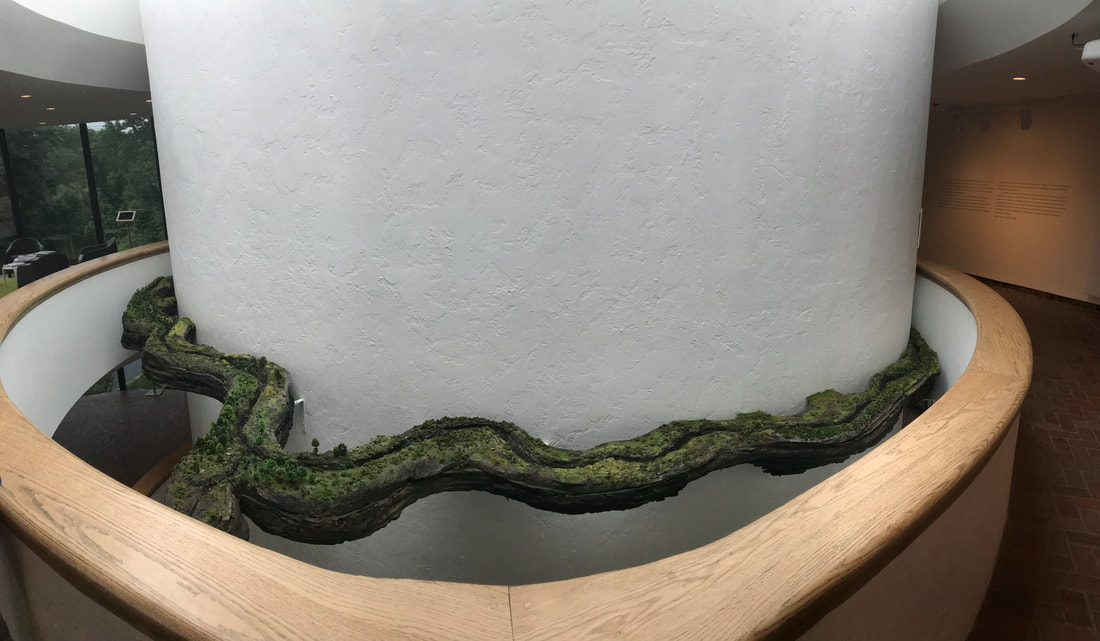
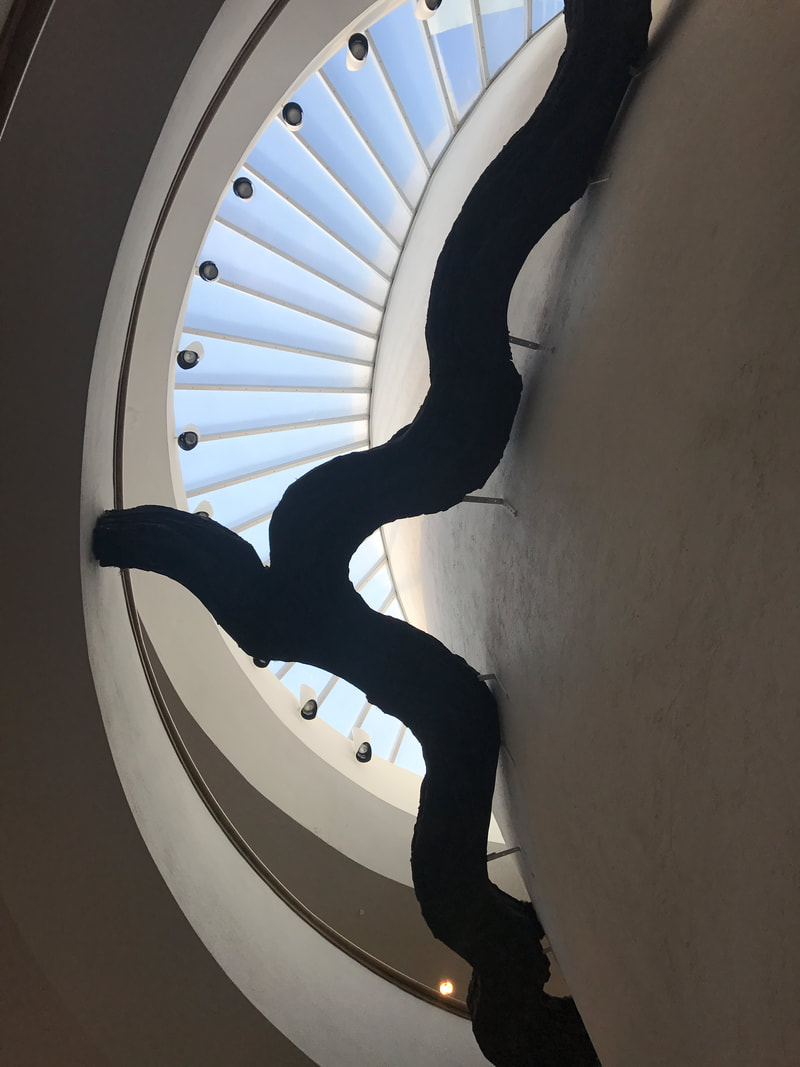
Anindita Dutta is a multimedia artist from India. Her work ranges from performance videos to sculpture and sculpture installations. Through the video sculptures Dutta began work on large sculpture pieces but since her work was in wet clay how to preserve the look and the intent of the original in the new pieces. And the mudwork is special to her.
“The mudwork, I have pushed that. I find it is totally mine. I have created a new medium.” she says.
The mud is wet and the people are covered in it and are a part of the piece. There is also a “fourth dimension” aspect to this work. Dutta says that the clay is wet throughout the shooting of the video and since wet clay becomes dry clay; actors have to perform in a short period of time.
But pieces like this are, in the real world, finite. You can shoot video and that is a second aspect of such an installation but it isn’t the same as the actual, physical piece. And, speaking practically, the clay videos are on such a large scale, a massive scale, who is going to buy a static piece like that?
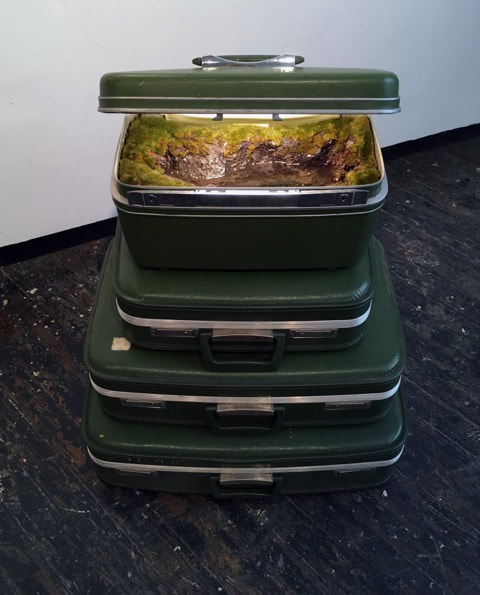
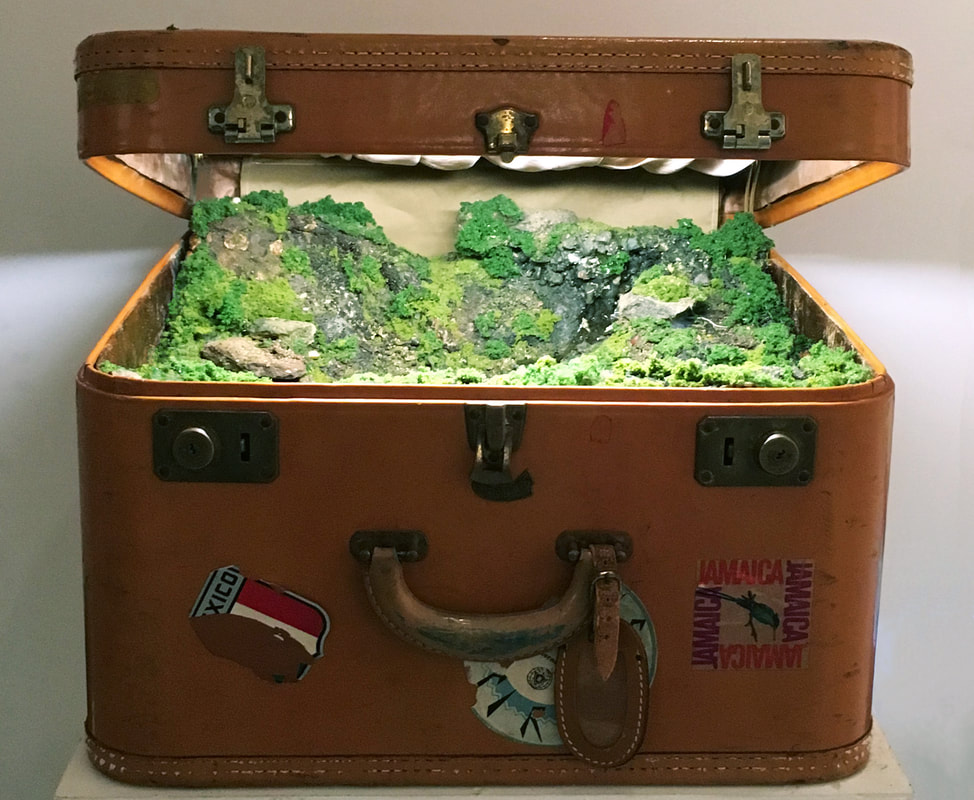
The next step was making something permanent using the concept but mud cannot be permanent. So Dutta moved to making sculptures that have the feeling of soft clay. It took a year to experiment with plaster, cement and other materials. And then there was the clay.
“Then there was mixing the clays from all over the world to try to make it permanent and look wet.” says Dutta.
The two pieces on hand, one small and one over five feet. And they do, indeed, look like wet clay.
(see below for examples)
Another work by Dutta, Trapped, was on display. It was a work that Dutta had sort of abandoned but came back to because so many people commented on it and praised it. She thinks, maybe, she didn’t understand it when she first worked on it.
“Some works you do spontaneously. You don’t understand how perfect it was but at a distance? Some works just happen a good feeling—I don’t know it just happens. Some people think when it is done it is over…but..” she says.
And the “but” is that you sometimes come back to the work and reassess it. Sometimes your original opinion adapts.
“The compliments I have gotten on this are; it is unique, not influenced by surroundings.” she says.
She also talked about how she would focus and obsess over a single piece of twine and how it sat. It is something that might make an artist crazy. But such attention to detail, especially in large pieces, is easy to imagine as the difference between a great piece and a good piece. And this piece is striking.
"Trapped"
Talking About "Trapped"
Dutta, whose husband is a bio-physicist at Purdue University, says she takes her Indian background and infuses other techniques into her art. She worked for 12 years in the West working on her skills. In addition to Indiana she has lived in New York City.
But what about India? You hear and see a good deal about galleries in China but what about India? Dutta says galleries in India are booming and they are supporting artists. There is one area for improvement though; Dutta says that critiques are an issue. She says it will take time for this to improve. Art breeds art critics so it is bound to improve!
Watch the videos to see interviews with Dutta on her clay works and also on Trapped.
If you’re looking for a lesson in early West Coast punk, Dave Travis is your man. After all, before taking time off to edit his countless homemade videos of 1980s LA punk shows into a cohesive documentary, titled A History Lesson Part 1, he taught middle school and high school social studies.
“As a teacher I taught history, geography, and economics. I really like geography,” says the man who known to his students as just ‘Travis’. “I have a degree in geography. When I was video recording, I needed a source of stable income, so I got a position as a teacher because I like teaching stuff.”
Travis’s love for teaching shows. In conversation Travis can hardly contain his encyclopedic knowledge on punk and punk history. And with A History Lesson, Travis is able to share the rise of the West Coast punk scene from his own eyes with home movies he shot as a teenager in LA County. And there is no man more capable of assembling such a collection as Travis, who witnessed the punk emergence from different vantage points. Travis saw it from the venue floors as an audience member, he experienced it from the backstage as a roadie, and eventually he created it from the stage as a performer in his own right.
Travis got his first taste of punk after seeing an X concert at a venue called The Whiskey.
“Seeing X and getting exposed to punk really opened things up to me,” says Travis. “At the shows there were always 200 to 300 people, with no restrictions between you and the band and where you can be. X was the best band I had ever seen live—DJ Bonebrake is an amazing drummer. It made me feel at home, and it made me want to come back.”
Travis went back many times, as indicated by the sheer amount of footage he has acquired over the years. A History Lesson Part 1 is the first in a series of compilations of these homemade movies, and film screenings are taking place throughout California. The screenings are followed by performances from local LA punk bands—legend Mike Watt of The Minutemen, one of the subjects of the film, has even joined A History Lesson on occasion, as has Travis’s own group Carnage Asada. The most recent screening was at the Ninth Street Independent Film Center as part of a benefit to help save the KUSF is a community radio station at the University of San Francisco.
The film conveys a feel for the early 1980s punk scene in LA. Travis includes performances he shot of iconic bands The Minutemen, The Meat Puppets, Red Kross, and Twisted Roots. Travis was specific in his choice of bands for the focus of his first film. As the title implies, these groups have certainly earned their place in the history of not only punk, but also popular music for their influential experimentation.
“The psychedelic elements of the featured bands definitely influenced a lot of later bands and groups from that area,” explains Travis. “Redd Kross and The Minutemen were different from everyone else in hardcore punk. Their songs didn’t just use that one-two-three-four, one-two-three-four structure. They were more experimental; they were among the first punk bands to experiment and include different styles, not just hardcore.”
Dave Travis playing at an elementary school Halloween carnival.
Like all good history lessons, Travis’s film acts as a link between the growing years of Generation X and its adult years.
“The Meat Puppets were a big influence on Nirvana, and they were one of the bigger acts who were able to travel outside the state,” continues Travis. “They played Washington, so they influenced those bands. The Meat Puppets just played wherever they could, just like The Minutemen and Redd Kross.”
Travis also picked those four bands for logistical reasons.
“I started chronologically. The first tapes I made were from 1983 to 1984, and the bands featured in the movie are from that early period,” says Travis. “They were chosen because they had the best quality video. Some of the bands from that period I couldn’t use because I couldn’t get permission.”
What separates A History Lesson from most rockumentaries is that Travis leaves his subjects’ performances in their original state: uncut and without voiceover. Furthermore, Travis’s film aesthetically captures the DIY ethic that is central to punk rock.
“The movie is really low budget. No one was hired, and I didn’t have anyone to help me,” says Travis. “The idea behind punk is that you do it yourself, otherwise no one else is going to do it, and that’s similar to what I did with this movie.”
In addition to live recordings, the film features interviews with members of each band.
“The interviews with Redd Kross, Twisted Roots, and The Minutemen are from 1994 to 1996,” says Travis. “That was when I was working with [Carnage Asada bassist] Dave Jones, who was working on a book about LA Punk. We taped the interviews for future use. For Meat Puppets, we just interviewed them when they were down here for a summer, that wasn’t too hard. Those weren’t the only interviews though. We interviewed whom we could; there were about 70 interviews.”
In the interview, viewers can see how the punk rockers compare to their onstage personas.
“The artists definitely become livelier onstage,” says Travis. “That’s common with the singers, like Jack Brewer and Keith Morris [of Black Flag]. It’s not that they become different people; they just become more energetic and livelier.”
Travis developed his interviewing style and learned the filming trade from his father.
“I worked with my Dad on shows like 60 Minutes and CBS News,” says Travis. “I worked on the sound, and while I was working on these news programs, I saw the interviews and that was how I learned journalism. I saw the questions they asked and learned how to interview. My Dad was the one who taught me the basic skills of using filming and video equipment.”
Mr. Travis never thought twice of how his son was honing his craft.
“My Dad just thought it was good that I was doing something,” says Travis. “He just wanted me to learn how to use the equipment, and the best way to learn is to practice. I was using hand-me-down equipment; I guess you could consider it on-the-job-training.”
Any editor, or teenager for that matter, would kill for the kind of training Travis experienced. The punk historian became a staple in the LA punk scene due to all the equipment he carried to live shows.
“I had on a VCR, like one you’d keep in a house, and I wore this lighting belt with motorcycle batteries and electrifiers that were used to power the camera,” says Travis. “It was not easy to shoot stuff and get around. The audience didn’t have any problems with me; at the shows I always saw the same people and they saw me. The bigger bands sometimes wouldn’t let me film them, but the smaller ones would want me to film them. My stuff would sometimes get messed up if someone would stage-dive on me. Now, people who want to film a show just use their iPhone to film shows, which I think is great.”
It is clear that Travis would have been grateful to have an iPhone for his filming his home movies, since technological constraints prevented his documentary from coming out sooner.
“Editing systems are so much better today, I was able to make the movie right on my computer,” says Travis. “Originally, you’d have to go from one VHS tape to another, and the tapes didn’t even have time codes, so you tracked your video by how the wheel was turned. This made editing very imprecise and you could cut off a fourth of a second of tape—but on a computer, you can get it really accurate, and when you need to try something else, there are different ways to edit a tape.”
All the equipment Travis had came in handy however, since the filmographer was able to participate in a southern California tradition: generator parties.
“We would do these generator shows because when you’re under 21, it’s hard to get into some shows,” says Travis. “So we got our own generator and PA system and set up these shows. We’d go out on the beach in Malibu; we did a show in an abandoned missile silo; we also did one behind this restaurant. We put on these shows all around LA. One time someone suggested we do a generator show in the desert. So in the middle of nowhere we’d set up the PA and just jam. Redd Kross and Sonic Youth were doing that before I did any shows, but I saw how they did it and it was so simple. I was inspired, so I borrowed my Dad’s equipment and put on my own.”
Travis then explained the significance of generator shows to the southern California punk scene as a benchmark separating the true fans from the casual listeners.
“The shows were fun, and they are still done today,” says Travis. “Desert shows have a different feel from regular shows since select people found out that they were going on, and then not everyone was willing to drive to the desert and hike two to three miles to the show. There was nowhere to park, so that’s what you had to do, and the people who do that must be very dedicated. The shows would go on all night until sunrise, and you could get really close to the band. Or you could go off to the rocks and watch nature, and the since it was out in the desert you could see the stars so clearly.”
After gaining notice for his filming capabilities, Travis gained editing experience working his way from underground films to MTV specials. He worked closely with director Dave Markey, who started out with cult hits before moving on to documentaries. Travis’s first project with Markey was the punk schlock classic Lovedolls Superstar, done with Markey’s own studio We Got Power.
“Dave had previously done Desperate Teenage Lovedolls, and for Superstar I helped with editing, shooting, and any other extra work,” says Travis. “I was still in high school at the time, but his friends had heard about me and they knew where I lived. When I was videotaping punk shows, it was not a common thing—not many other people were doing that. So word spread and Dave came to me.”
Travis’s work on the underground film showed the emerging editor how DIY was not just an onstage concept. Travis was able to see this DIY ethic in comparison to the work his father did for CBS.
“It was different than working for CBS,” says Travis. “CBS is a corporation where everyone has one position and one job to do. At We Got Power, it was just Markey, Jordan Schwartz, and whomever they had to help them out with whatever they could. There are few people who do what they can. While shooting the movie, I saw that most of the lines were improvised, and it was really just a bunch of friends having fun making a movie.”
While with We Got Power, Travis was still working alongside family: his sister Abby worked on the Lovedolls Superstar soundtrack.
“The funny thing about that is, the movie was about a fictitious band called The Lovedolls, and then a real life Lovedolls band started up, and it included my sister. But, she wasn’t in the movie band at all; she just made a cameo appearance.
Also, on the soundtrack were Dead Kennedys and Sonic Youth. Even though Sonic Youth is from New York, they came to LA in 1985 and played at a desert party with Meat Puppets and Redd Kross, who did most of the Lovedolls soundtrack. They became friends with the guys in Redd Kross, and through them they met Markey, and through him they were able to get a spot on the soundtrack.”
On the other side of working with Markey, Travis participated in serious film work as well. The two were tasked with making a Kurt Cobain tribute for the 1994 MTV Video Music Awards.
“Making the tribute was heavy stuff,” says Travis. “We went through a lot of material, watching all their footage and interviews. Markey directed and I edited, and we were happy to do what the Nirvana people wanted. It was a heavy experience to being there with them and watching the footage, which they’d never seen before. They were good people to work with, even under those heavy circumstances. They were big stars, but they weren’t assholes or anything.”
It had only been two years since Travis finished working with Markey on the director’s magnum opus, the punk and early grunge documentary 1991: The Year Punk Broke.
“After Markey accompanied Sonic Youth on their European tour with Nirvana, he came back to LA with all this footage which I edited and transferred to video, using each song as a video and the live audio recording,” says Travis. “It was a good project, and it was fun since it let me listen to Nirvana and Sonic Youth every day.”
Travis is not just an avid listener and documenter of punk rock; he also creates it. His A History Lesson project has not only given new life to his home videos, but also to his psychedelic punk group Carnage Asada. Through Carnage Asada, Travis is living the life he witnessed through the lens of his handheld cameras, and he is able to be an active part in keeping the alive the punk ethics of DIY and camaraderie.
“With the groups I play with,” says Travis. “There’ll be a guy who plays in two to three bands, and the guys in those bands play in two or three other bands. It creates a web. You come to understand a band better because you understand the people in them and you’ve jammed with them.”
Carnage Asada, as a frequent follow-up act to a History Lesson Part 1 screening, is gaining greater exposure and more work.
“We’ve been working on our new album,” says Travis. “We recorded the songs back from 2003 to 2004, and we’re in the process of mixing it now. Hopefully this spring we can record some stuff with our new guitar player Tony Fate.”
Carnage Asada is not Travis’s first experience travelling with a punk band, however. Back in the 1980s, Travis knew the groups of his hometown well enough that he would tour with them, giving him a firsthand account of the spread of punk across the West Coast.
“I went on tour with Killroy in 1984 when I was just 16 years old,” says Travis. “For that tour we went to all these small towns, and their punk scenes were different compared to that of LA. In LA, punk had been well established, but it was groups like Killroy were bringing punk to these small towns.
In 1985, I traveled with Redd Kross on their tour. They were a better band and they put on better shows, and back then there were no restrictions on driving for kids like me. In 1991, I went on tour with Celebrity Skin, working as a roadie and a soundman.
As for interesting stories, I remember when touring with Celebrity Skin, their drummer Don Bolles was eating at a Waffle House with us, and someone from the band put $5 in the jukebox and played Waffle House songs until he cried.”
Travis continued to tour in 1990s, only by this time he had made a name for himself as a musician. It was his time to observe shows from the stage itself.
“In the 1990s I joined this band WACO and played cello for them; we went on a few tours. It was always interesting to see different places, and the experience certainly made high school more interesting,” says Travis. “There were a lot of punkers right in LA; there always were.”
There always will be too, as Travis has learned during his time as a social studies teacher.
“I taught in South Central LA, and while I thought there were a lot of punk rockers there, there were more than when I was in high school,” says Travis. “When I was in school, it was new; punk rock was still catching on. Now, almost 25 years later, the younger students knew certain bands that had different influences. I saw high school bands forming between friends with common interests who just wanted to play. I watched as they started out playing at parties to getting their own shows.”
Travis’s students have returned the favor by serving as audience members at his History Lesson screenings.
“I do see former students at the History Lesson screenings, and I go to talk to them,” says Travis. “They’ll come to my Carnage Asada shows—as a teacher I wasn’t antagonistic or anything. We’re always happy to see each other. To them I never was ‘Mr. Travis’, I was always just Travis.”
The historian known simply as Travis will continue teaching his unique history lesson, as he already has a second film lined up.
“We’re working on A History Lesson Part 2, and I’ve learned some things from making the first movie,” says Travis. “For Part 1, I edited all the interviews first, then I tried to get the clearances. I profiled 12 bands originally, but I was only able to clear four of them. For Part 2, I have to figure out who I generally want to use and get them cleared first.”
The only confirmed band for A History Lesson Part 2 was Saccharine Trust, and Travis has a history with the South bay punk band’s eccentric frontman.
“Saccharine Trust will be featured in Part 2; they were another SST band that worked with Black Flag,” says Travis. “I worked with their singer Jack Brewer on this poetry record he did. He’s really cool, and the thing about the record was that all the songs, they were live recordings we did at the Hollywood Christmas Parade. We recorded him reciting his poetry on Hollywood Boulevard as the parade went by. He has such intense words; it was all pretty interesting.”
Until them, the Part 1 screenings and Carnage Asada shows don’t look like they’ll be stopping anytime soon.
Experimental hardcore group Pierce the Veil has finally pierced the charts with their sophomore album Selfish Machines. First generating buzz with A Flair for the Dramatic in 2007, the latest album from the San Diego foursome debuted at #1 on Billboard’s “Heatseekers” Chart.
Despite their newfound success, the members of Pierce the Veil remain down-to-earth in their attitude and personality. The fun-loving, easy-going nature of the band is embodied in their frontman, Vic Fuentes. Fuentes founded the group alongside his brother Mike, the drummer for Pierce the Veil. The group is completed by bassist Jaime Preciado and guitarist Tony Perry.
The group received a lot of exposure this year on the Warped Tour, known for showcasing new talent in punk, ska, and rock. The group has become a staple on the hardcore travelling festival circuit, having previously performed on the 2008 Warped Tour and the 2009 Taste of Chaos tour. At the time of this interview, Warped Tour had just finished playing in Wisconsin.
“Oh, Milwaukee was great man” says Fuentes. “It was a great show, awesome weather, the best weather of the whole tour. As for technical difficulties, every day one thing goes wrong, but it’s never a big deal.”
The band is hoping for further exposure when the music video for the first single off Selfish Machines, Caraphernelia, is made ready for television and internet. Fuentes is enthusiastic about the video and about working with director Robby Starbuck.
“It was cool; I was very surprised by the amount of production that went into the video. We shot it on a little set, and there was a crew and some pyro guys and we were like, ‘Wow this is crazy!” he says. “…It was really cool. Jeremy McKinnon, who did a cameo in the song, we wanted him in video but he was in Europe. So they actually shot his stuff overseas, the parts with him in it were done in Europe!”
Along with festival shows, Pierce the Veil has become well known through their extensive touring schedule. Playing festivals and headling tours, especially for a band still making their name, is a contrast.
“They’re so different, it’s hard to say. We love club tours; we are huge on playing live. The good thing with playing venues like Warped Tour is that it is an outdoor festival with tons of people and a larger stage,” says Fuentes. “Playing an outdoor festival as opposed to a club definitely changes it up. You have to treat each venue differently.”
Like most musicians lucky enough to have both experiences Fuentes cannot pick one over the other.
“I can’t really say. I don’t prefer either venue, I mean Warped Tours are just so crazy; so many people come out. We just love playing, so any gig we get is fun.” he says.
Fuentes says the band has brought their touring experience into the studio with them, and this tour-influence can be especially heard on Selfish Machines.
“Our whole record was based off of that, that raw emotion and experience [of touring],” he says. “We toured for three years before we started recording, so the emotion that is such a big part of the record comes from inspiration from the fans.”
As much as touring another major inspiration of Pierce the Veil is their home town.
“San Diego is a huge part of Pierce the Veil. We all grew up on SoCal punk, we looked up to those guys,” says Fuentes. “That whole scene was so influential to us as a band.”
Regardless of influences Fuentes says the focus of the band is squarely on their fans.
“We always try to do a full-on show for the kids, so we put lot of effort into our shows,” he says. “We take time to decide what songs we’ll be playing, you know, what covers; make sure to include some sing-a-longs for the fans.”
Pierce the Veil is also known for an eclectic selection of cover songs. Showcasing their experimental nature at a recent concert in Pittsburgh, the group played a hard rock rendition of Michael Jackson’s 1982 pop classic, Beat It.
“It was fun, I love doing that stuff,” says Fuentes. “It’s hard to take an old style and reconstruct it; you have to see how they originally did it and how they recorded it. This helps us as a band though, it really expands our style. It was fun to play it live; I mean everyone knows Beat It. We recently played ‘Don’t Fear the Reaper’ in a similar style, and the crowd loved it.”
Selfish Machines, made a 400% sales increase over its predecessor. The album also marks a change in the state of the band, in that all the members were actually present.
“The recording process for Selfish Machines was a lot different from the process for A Flair for the Dramatic. The first album was just me and my brother playing, but luckily Tony and Jaime were in the group this time around. It’s cool to have the band with us,” says Fuentes.
Even though they’re newcomers, the other members of Pierce the Veil have become acclimated with the band.
“The other members are totally integrated into the band. We’ve toured so much and grown super close. We’re like family; they’re like brothers to me. They are a huge help to the band, especially when we play in preproduction. They are huge to the process, and they are really good as musicians.”
Fuentes also credits location to improvements on the second release. “Also, we were actually able to record in LA this time around, as opposed to Seattle where we recorded our debut. Sure, there was too much industry and people around, but the finished product came out really good,” says Fuentes. “It’s a progression from album to album, and hopefully we get better as we go. We really like the new record; both reflect different periods of our lives and our set goals at the time.” Despite now being, themselves, part of a musical trend, they were never followers.
"People need to try not to go with trends; you need to go with what you want. You need to try and be happy with your band, you know,” says Fuentes. “You should try not to write about break-ups just because it’s what’s popular. I’d rather do my own thing than sound like everyone else.”
But it isn’t all wine and roses; Fuentes has some apprehension over the current state of the music business.
“The industry right now is confusing. It’s been around long time, and I still don’t understand it. I don’t like the business part of music, I don’t like dealing with it. I much prefer to write songs and play guitar. Dealing with the business end, it’s scary,” says Fuentes. “A lot of bands really get fucked over because of it. You have just got to find someone you can trust to take care of that aspect.”
Fuentes is known for his very emotional, personal lyrics that deal with such topics as loss, break-up, and heartache. Wouldn’t a frontman associated with the heavy hardcore music scene be worried of becoming too vulnerable to his fans?
“Not really, I’m not too concerned about revealing stuff to the fans. I have no problem writing about revealing stuff. It gets tricky when you’re writing songs about particular people and when they know it’s about them. Our song Caraphernelia is about my ex-girlfriend named Cara, and I had to actually talk about the song to her.” he says. “But it has to be real, songwriting can’t be fake. I hate bands that clearly made up the lyrics to their songs on the spot without putting any emotion into it.”
And there is a personal benefit to this, beyond just a heart wrenching song.
“..The therapeutic factor is definitely why we play music; it’s what we love to do. Our studio in San Diego is my favorite place in the world; it’s huge for me. I especially love playing with my brother; it’s great to do this with family.” he says. And how about playing with your brother in a rock band? That could be a dream or a nightmare. “It’s amazing. We’ve played together since we were little kids, so there’s, like, this higher sense of connection that we have. It’s like, there’s a point where I can sense what he will do before he does it,” says Fuentes. “Our connection makes the writing process easier. I admire my brother, he’s a fantastic drummer and he’s very talented.”
Fuentes concluded the interview, in typical, Pierce the Veil fashion, with a shout-out to his fans; “We love you and always enjoy seeing you at our shows!”
Pierce the Veil will be bringing their unique heavy post-rock sound to Australia come September.
New Orleans’ Caddywhompus puta new spin on the Crescent City’s musical tradition, a psychedelic pop spin. The band is a duo comprised of guitarist/vocalist Chris Rehm and drummer Sean Hart. This is one group everyone with a taste for underground, experimental pop should get to know.
Rehm and Hart formed Caddywhompus in 2008 following the split of their prior band, Houston outfit, Riff Tiffs. The two have known each other since kindergartenand have played together since middle school.
Since then, the duo have been busy building a strong fan base in the indie music scene. They are out on their 2010 summer tour promoting their sophomore album, Remainder, released May 11. Remainder follows their first album, EPs, a compilation of Caddywhompus’ first EP, four songs from a prior split cassette and two unreleased tracks. This tour started on the West Coast before heading East. Hart says the tour has been a blast, though the group has had the standard brushes with strangeness that come with every tour.
He recalled one odd instance in Orem, Utah.
“We went to this venue it was called ‘The Kage’ with a K and we were supposed to play with these 6 local bands, but then the owner canceled the performance when he supposedly received noise complaints from the cops,” said Hart. “Though, we found out later that this never happened! The venue itself was strange. We were in what looked like a preschool classroom. There were Shrek posters everywhere.”
Sean Hart recounted the group’s experience touring and playing with other bands, including critically acclaimed group The Antlers.
“Playing with The Antlers was cool. I didn’t know too much about them before we met, but Chris owned a copy of their first album [In the Attic of the Universe].” says Hart.
The Antlers jammed with Caddywhompus at the Saturn Bar in New Orleans, the location for the band’s CD release party for EPs.
“The Antlers were super nice and fun to hang out with,” continued Hart, “and the performance worked both ways.”
Hart explained that playing with The Antlers helped to promote EPs, and playing in New Orleans certainly helped the Brooklyn-based Antlers spread their fan base to the untapped South.
Hart also said he enjoyed playing a short tour with Lafayette-based outfit Givers.
“That was really fun.They had their own trailer and a tour van, so it was a nice change to not have to drive to our gigs! We ended up playing a sold out show at Emo’s in Austin; that was great.” he says.
Caddywhompus' Guilt by Nelo Neko Films
Additionally, Caddywhompus released their first professionally produced music video. The group collaborated with the independent, Texas-based Neko Neko Films to make a video for the song Guilt. The video captures the band’s eclectic style and sound with jarring camera work, rapid transitions and hazy visuals. Hart noted the interesting experience the group had with Neko Neko.
“It was really random. They just showed up one day at our place in New Orleans, and for the video they had us play Guilt four times while they recorded in our practice room where we recorded all of Remainder.” says Hart.
Caddywhompus’ first music video was for their song Absinthesizer. Hart explained a friend made it in the library at Loyola University New Orleans, where the band attends college.
When it comes to balancing college life and band life, Hart says that school can wind up taking second place.
“Sometimes, college has to be put on the back burner. Sometimes, we don’t even want to go to class," he says. "Luckily, we attend a music school, so we’re always excused when we have a gig to worry about. We make it work. We don’t do too many shows during the school year, maybe one a month."
The group has really shown their 21st century DIY work ethic with an assortment of online profiles. Rehm updates a Facebook page and a blog while Hart maintains a band MySpace profile. Hart attributed Caddywhompus’ level of success to the word-of-mouth publicity that occurs on the blogosphere, where fans and curious music-listeners can enjoy their uploaded songs. Indeed their whole current record is available free at the Community Records website.
Unlike their debut album EPs, whose 300 copies were produced entirely by the band itself and sold through PayPal. Remainder, as mentioned, is promoted and distributed by Community Records.
The name “Caddywhompus” comes from southern slang meaning “crooked, or uneven.” According to Hart, he and Rehm used to hear their friend’s grandmother use the term. “Caddywhompus” was originally the name of a high school band Hart and Rehm started. The name fell out of use but somehow seems appropriate for their experimental, “crooked” rock sound.
Keep an eye for the band on tour, download the new recording (it won't cost you a thing) and spread the word about the cacophonous, DIY, psychedelic sound of Caddywhompus.
Frazer Bradshaw doesn’t want you to just his watch movies. He wants your participation. Not in the Rocky Horror sense. He doesn’t want you to dress up like Tim Curry and prance about (although we doubt he would seriously object should an overwhelming urge to do so take you).He actually wants you to exercise your mind.
Bradshaw is a director and cinematographer. He has been cinematographer on 35 films and directed/editor five more (three of which he also wrote). His most recent film, Everything Strange and New is a narrative drama that uses both voice-over and music in innovative ways.
“Actually the music was part of the genesis of the film. The shot of the back of the character’s head looking out with cacophonous music is the visual moment that drives the rest of the film.” says Bradshaw.
The music, by Dan Plonsey and Kent Sparling, is a cacophony that stands in direct opposition to the sedate visual imagery. This disconnect is by design and, indeed, is part of Bradshaw’s philosophy of film.
“Music and voice over are things radically misused in films. To me music has to not support the film but offer something new.” he says.
The image and music in that first shot creates something you would not get with just the shot or the music alone. The feeling is expanded by the music. It means something more and something different because of the music. In Bradshaw’s film, and probably in every other film, music can change the relationship between people and landscape. And it does so profoundly.
“Music can change that relationship in a chemical way.” says Bradshaw
Bradshaw uses voice over in a way that is out of the ordinary as well.
“The voice over works much like the music. You never see a character when you hear the voice over. To me, that is the worst thing you can do. If you are seeing someone thinking it becomes false” says Bradshaw. “The voice over is never about what you are looking at.”
Like music he juxtaposes two things do not inherently have a relationship. It expands the movies ‘meaning palette’ he says and allows more interpretation by the audience. And that is a key to this film.
Bradshaw says that with studio films there is nothing between the lines. They are something you can watch and keep your distance. This is not criticism but an observation (Bradshaw often works as a cinematographer on studio films). Bradshaw wants his films to be a mirror for the audience. A mirror forcing them to be almost a part of the movie
“If I have one goal as a filmmaker it is to open things up to interpretation.” he says.
Whenever he has the opportunity to add or change part of the film the same thought comes to him; “I think about what are the implications for broadening or contracting of the film around the shot.” he says.
His films mean what they mean to you, to me, to anyone who watches, as much as they mean what Bradshaw was thinking while shooting. Indeed, this one thing is ever present in his mind is how to expand possible interpretation rather than restrict it.
If you want to see Everything Strange and New you may have to wait until a DVD release. Its theatrical run has been intermittent.
“It is not in any theaters, or it may or may not be but it is still, in theory, playing theatrically,” says Bradshaw; he then adds a tad of self criticism. “I made a mistake. I made a film about people who do not go to movies. People want to see movies about themselves which is a sad state of affairs.”
You may notice there hasn’t been much plot summary. There is a plot. The film is a “slice of life” about a working man, with two kids and a mortgage working to get by. But it is as much about the audience’s reaction to the life he and his friends lead. It is as much about the somnambulistic way he moves through his life and word and how the good blends with the bad.
The film is also not about what it is about (if that makes sense). And sometimes, we, the audience, like to be told how to feel and know, with certainty what the meaning of a film is. We are not used to being challenged. This film’s aim, and Bradshaw's, is a bit more esoteric.
“It is about the effect of watching the film. It is hard to talk about film as experience rather than a movie,” he says. “I need people to relate to the film in a way they would not normally relate to a movie. Ultimately it is not to tell a story but to give a visceral and emotional experience.”
The film was also shot on Super 16 and feels almost like a series of photographs. The “action” taking place as much in the character’s minds as in the physical action itself. This disembodiment of the characters likely comes from Bradshaw’s background. As a youngster he never thought about becoming a filmmaker. Bradshaw went to art school and became interested in film because he liked reflected light.
“I wasn’t one of those guys who saw Star Wars and wanted to make movies. I wasn’t interested in making films until college.” he says.
Unsurprisingly he wasn’t initially interested in narrative films but rather experimental ones.
“Generally I like to answer my biggest influences are directors I work for as a cinematographer.” says Bradshaw.
When the subject of influences arises he initially talks about various European directors such as Tarkovsky and Bergman. But his real influences come from his job as a cinematographer.
“Generally I like to answer my biggest influences are directors I work for as a cinematographer.” says Bradshaw.
He gets to see these directors succeed and fail, sometimes on a grand scale. They make his mistakes for him. Most directors do not have the benefit of such experience. Bradshaw learns what he doesn’t want to do as much as what he does.
“There is inherent risk in making a good film.” he says.
But he gets to take risks that are “less risky” because he has witnessed other directors making similar decisions.
As to what is next Bradshaw is writing something and is working on what he refers to as a “straight forward documentary project”.
Bradshaw was also cinematographer on the film, Babies. Whenever this film is mentioned to the cynical film snob they think it is about Anne Gedde. It is, in fact, more like a BBC nature film. He is also credited with being an “additional photographer” on the documentary about Townes Van Zant, Be Here to Love Me. He says (and makes a compelling case) that a “director of photography” credit would have been more appropriate. There was a break in filming and after that, there was a new director of photography.
“I made $93 a day as a favor to Margaret (Brown),” he says. “After six weeks we ran out of money. I went home. Margaret started dating Lee Daniel and when they started shooting again. Well, you can’t beat free boyfriend labor.”
And if you are into innovative, thoughtful filmmaking you cannot beat Everything Strange and New.